Enter your zip code above to find your hardiness zone, plants available for your area, and your estimated ship date.
To the left, you'll find all the topics covered in this Plant Manual. Select a topic to read its information.
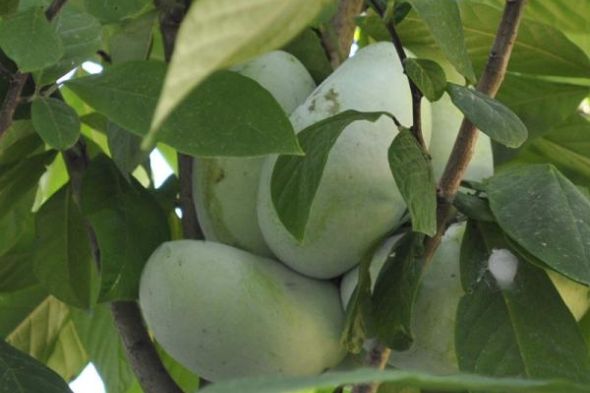
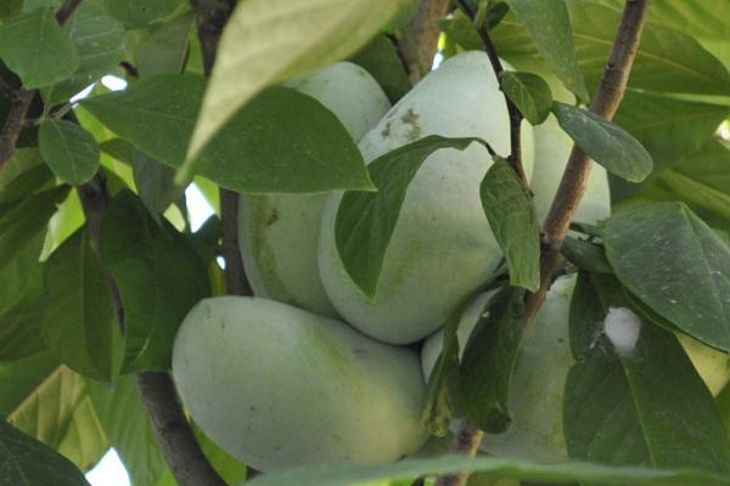
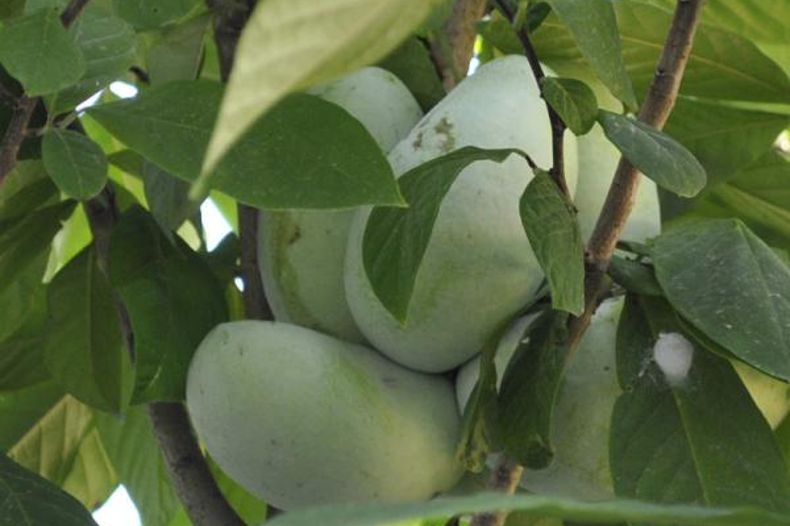
Extra sweet fruit. This tree yields abundant crops of 25-50 pounds when mature, perfect for baking, canning or cooking. Cold-tolerant. Best to plant in neutral soil, partial to full sun. Ripens in late September. Grafted. For proper pollination, plant another grafted pawpaw variety.
The best way to succeed is to plan before you plant. Let’s discuss location: Do you know where you want to locate your new plant? Avoid many future problems by considering all aspects of the planting spot, such as:
Is a pollinator variety present? Cross-pollination by a different variety, of the same type of tree, is key to the success of many fruit trees. In most cases, its absence is why trees don’t bear fruit or produce poorly.
Your tree would love a sunny place with well-drained, fertile soil. But it will be quite satisfied with six to eight hours of sunlight. Good drainage is required to keep your trees “happy.” If your soil has high clay content, use our Coco-Fiber Potting Medium or add one-third peat to the soil at planting time. We do not recommend planting fruit trees in heavy, pure clay soils.
Even if your yard isn’t the most ideal location, take heart. Fruit trees are very adaptable and respond well to fertilizers, so they can get along well even where the soil is nutritionally poor. Just steer clear of sites with extremely heavy soils or very poor drainage.
If you’d like your tree to become a landscaping asset, choose the planting place with this in mind. Imagine it as a full-grown tree and check everything out: Wires overhead? Sidewalk underneath? Does it obstruct something you want to see? Can you keep an eye on it from the house? Will other trees be in the way, allowing for their additional growth in the meantime?
Even a year or two after planting, your tree will be very difficult to transplant. So take the time to plant it in just the right place.
First-time fruit tree growers often ask about recommended planting distances from patios, sewer lines, water pipes and so on. Ordinarily, patios will not be a problem because the soil beneath them will be dry and compacted. Therefore, the roots will not grow into this area as much. It’s still recommended, however, that you plant at least 8-10’ away from patios, water pipes and sewer pipes. You might not expect sewer and water lines to be affected since they are buried so deeply. But, since sewer and water lines tend to be wet, roots will grow to them and around them if the tree is planted too close. By planting your trees far enough away from these items, you can avoid this problem.
Once you’ve found out about fruit growing goodness firsthand, you’ll want to expand your home orchard. It’s important to plan for tree spacing so that the future growth areas will be ready when you are.
One way to help you visualize your exact tree spacing is by staking out the positions of your present and future plantings. But how do you make sure the hole goes where the stake is? One method is to prepare a notched planting board. The planting board is used to show where the original position was after the hole was dug. To use it, simply put the stake in the tree notch as indicated and then put stakes on each end. Then, remove the board and dig the hole. When the hole is big enough to accommodate the roots, replace the board between the two stakes and place the tree in the tree notch. Use the planting board as a guide, keeping the tree erect. The planting board can be used over and over again.
Successfully establishing a young fruit tree in your yard starts with your planting site and method. Once a fruit tree is established, it needs little assistance to grow and bear fruit; but you’ll want to make sure you give your trees the right foundation.
Stark trees that are grown and shipped in bottomless pots are part of our continuing quest for producing better and stronger trees for the home grower. By following these simple instructions, you will be assured of getting your young tree off to the best possible start.
Fruit trees require fertile soil for good growth, so before you plant, check your soil pH. Contact your local County Extension Office for information about soil testing in your area, or purchase one of our digital meters for quick and accurate results. Pawpaw trees enjoy a soil pH of 5.5-7.0. Steer clear of soils that are extremely heavy or poorly drained.
A pawpaw’s flowers have both male and female reproduction parts, but they are not self-pollinating. Also, the female stigma may mature and no longer be receptive when the male pollen is shed. They do require cross-pollination from another pawpaw tree. Bees have little interest in pawpaws; flies and beetles can do some pollination. The best solution is to pollinate by hand. Male pollen is ripe when the ball of anthers is brownish in color and loose. When collected, pollen grains will appear as small, beige-colored particles on the hairs of an artist’s brush. The female part of the flower is receptive when the tips of the pistils are green, glossy and sticky.
Preparing your soil before you plant will greatly improve your plant’s performance and promote healthy, vigorous growth. It is a good idea to have your soil tested to determine if it is lacking in any essential minerals and nutrients. This can be done through your County Extension Office or with one of our digital meters.
The goal of soil preparation is to replenish vital minerals and nutrients, as well as break up and loosen any compacted soil.
Soil preparation can be done at any time that the ground is not too wet or frozen. Your trees may be planted even when temperatures are quite cool. If a hard frost is expected, it is advisable to delay planting for a while until temperatures become more moderate. Generally, as long as your soil is workable, it is fine to plant.
Your lawn can provide you with ideal organic materials such as grass clippings and shredded leaves. Not only will the grass and leaves break down to provide soil nutrients, but they will help loosen the soil as well. You can gather these in the fall with spring planting in mind.
Adding organic materials, such as our Coco-Fiber Potting Medium and compost will improve most every soil type. Organic materials bind sandy soil particles so they retain moisture and nutrients better. They also break apart clay and silt particles, so that water can infiltrate and roots can spread.
Pawpaws are sensitive to fertilizer their first couple of years, so apply Stark® Tre-Pep® sparingly. After your tree is more mature, follow the guidelines below.
Every fruit tree has the future potential for disease and insect damage. Factors such as location and weather will play a part in which issues your tree encounters. If available, disease-resistant trees are the best option for easy care; and for all trees, proper maintenance (such as watering, fertilizing, pruning, spraying, weeding, and fall cleanup) can help keep most insects and diseases at bay.
Adequate nutrition is as much a tool in disease control as the use of sprays. Plants deficient in potassium, phosphorous and magnesium are more susceptible to attack by black spot and powdery mildew. Simply increasing the potassium (sulphate of potash and/or lucerne mulch), phosphorous (rock phosphate or chicken manure) and magnesium levels (Epsom salts) helps to make plants more resistant to disease. Pawpaws are most susceptible to black spot disease during the cooler months. Spraying with sulphur or copper based compounds prior to the onset of the cool weather and watering with liquid seaweed can help reduce the severity of infestations.
Disease causing defoliation and black spots on leaves and thrives in moist conditions. Twigs may also be infected. Black spots are circular with fringed margins, if severe, spots can combine to cause a large black mass, can weaken and kill plants.
Control
Whitish-gray powdery mold or felt like patches on buds, young leaves and twigs. Leaves may crinkle and curl upward. New shoots are stunted.
Natural Control
Caterpillar feeds on leaves, buds and twigs.
Control
Caterpillar appears initially all black before developing black and yellow stripes and feeds on the underside of leaves.
Control
Most potted fruit trees need very little initial pruning, but as the trees get older, corrective pruning may be necessary. The top two reasons you should prune your pawpaw tree is for stimulation and shaping.
Keep these pointers in mind:
Spraying is important to the survival of your trees. To handle potential diseases and pests, reference the guidelines below to know what you should spray, and when you should use it.
Before you begin, read and follow all instructions on labels.
The following guidelines can be used to ensure your pawpaw tree receives the proper amount of water during it’s life cycle.
Are you ready to enjoy delicious homegrown fruit? Harvest is the time to enjoy the results of your hard work. Keep a few things in consideration as you reap the fruits of your labor: the best time to pick the fruit from your tree, and how to store the fruit.
This native North American fruit has delicious custard like flavor. Pawpaws normally start bearing fruit in the sixth or seventh year, so have patience and reap the rewards in a few years.
Pawpaws begin to ripen mid-August thru September. Harvest them when they are soft to the touch. If you give the pawpaw a gentle squeeze the skin will usually lighten from green to yellow or brown. Occasionally they will develop blackish splotches. These splotches do not affect the quality of the fruit.
Annual average yield per tree: 1-3 bushels, 9 pounds at 5 years old.
Pawpaws will keep for 2 to 3 days if picked ripe. If not fully ripe, they will keep up to 3 weeks refrigerated.
Trees that are shipped without soil to ensure good contact with soil in your yard. When shipped, they are about 3-4' tall with 3/8" or larger trunk diameter. When they mature, they will be one of three sizes*:
Matures to be about 8-10' tall and wide. Provides an abundance of full-size fruit.
Matures to be about 12-15' tall and wide. Gives maximum fruit yield per square foot.
Matures to be about 15-25' tall and 20' wide. A multi-purpose fruit and shade tree.
Top-grade, bare-root trees that give you a head start on growing. When shipped, they are about 4-5' tall with 5/8" or larger trunk diameter.
Trees in bottomless pots that allow some roots to be air pruned, so that a dense mass of productive, feeder roots can grow within the pot to make transplanting easier. Mature sizes vary. When shipped, they are about 1-2' tall.
Top-grade, potted trees chosen to give you a head start on growing. When shipped to you, they are about 3-4' tall.
*Tree sizes may vary by variety. See our Growing Guide for details.
Since 1816, Stark Bro's has promised to please customers with the very best fruit trees and landscaping products, no matter what. It's just that simple. If for any reason you are not completely satisfied with your purchase, let us know within a year of delivery and we will send you a free one-time replacement or refund your full purchase price if you don't want a replacement. To receive your replacement or refund, please call 800.325.4180. This warranty gives you specific rights, and you may also have other rights, which vary from state to state.