Enter your zip code above to find your hardiness zone, plants available for your area, and your estimated ship date.
To the left, you'll find all the topics covered in this Plant Manual. Select a topic to read its information.
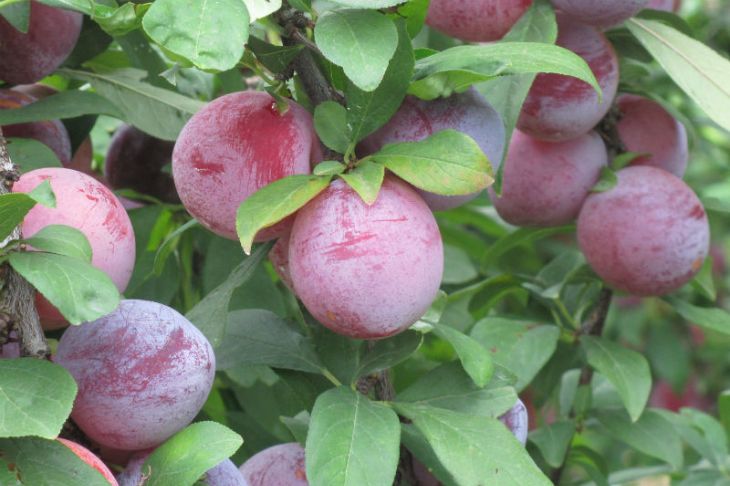
These plums are used in blue ribbon-winning preserves. This consistent bearer produces heavy crops of medium-size plums that are tart and juicy. The tree is vigorous and hardy. Ripens in September. Self-pollinating.
The best way to succeed is to plan before you plant. Let’s discuss location: Do you know where you want to plant your new trees? Avoid many future problems by considering all aspects of the planting spot, such as:
Is a pollinator variety present? Cross-pollination by a different variety, of the same type of tree, is key to the success of many fruit trees. In most cases, its absence is why trees don’t bear fruit or produce poorly. Since insects and wind carry pollen from one blossom to the other blossoms the trees should be planted fairly close together, within 50 feet.
Your tree would love a sunny place with well-drained, fertile soil. But it will be quite satisfied with six to eight hours of sunlight. Good drainage is required to keep your trees “happy.” If your soil has high clay content, use our Coco-Fiber Potting Medium or add one-third peat to the soil at planting time. We do not recommend planting fruit trees in heavy, pure clay soils.
Even if your yard isn’t the most ideal location, take heart. Fruit trees are very adaptable and respond well to fertilizers, so they can get along well even where the soil is nutritionally poor. Just steer clear of sites with extremely heavy soils or very poor drainage.
If you’d like your tree to become a landscaping asset, choose the planting place with this in mind. Imagine it as a full-grown tree and check everything out: Wires overhead? Sidewalk underneath? Does it obstruct something you want to see? Can you keep an eye on it from the house? Will other trees be in the way, allowing for their additional growth in the meantime?
Even a year or two after planting, your tree will be very difficult to transplant. So take the time to plant it in just the right place.
First-time fruit tree growers often ask about recommended planting distances from patios, sewer lines, water pipes and so on. Ordinarily, patios will not be a problem because the soil beneath them will be dry and compacted. Therefore, the roots will not grow into this area as much. It’s still recommended, however, that you plant at least 8-10’ away from patios, water pipes and sewer pipes. You might not expect sewer and water lines to be affected since they are buried so deeply. But, since sewer and water lines tend to be wet, roots will grow to them and around them if the tree is planted too close. By planting your trees far enough away from these items, you can avoid this problem.
Once you’ve found out about fruit growing goodness firsthand, you’ll want to expand your home orchard. It’s important to plan for tree spacing so that the future growth areas will be ready when you are.
Dwarf, 8-10'
Semi-Dwarf, 12-15'
Standard, 18-20'
Successfully establishing a young fruit tree in your yard starts with your planting site and method. Once a fruit tree is established, it needs little assistance to grow and bear fruit; but you’ll want to make sure you give your trees the right foundation.
Fruit trees require fertile soil for good growth, so before you plant, check your soil pH. Contact your local County Extension Office for information about soil testing in your area, or purchase one of our digital meters for quick and accurate results. If the soil pH where you plant your tree is 6.0-7.0, you’re in good shape. Take a look at the established trees and plants around the site. If they look healthy and are growing well, just follow the recommended fertilization program for your fruit trees. Steer clear of soils that are extremely heavy or poorly drained.
Grafted trees need special planting attention. All Stark Bro’s fruit trees are grafted or budded, the only methods for growing true-to-name planting stock. You can see where the fruiting variety on top is joined to the root variety on the bottom by a bump in the bark, change in the bark color or a slight offset angle. For certain dwarf trees, it’s very important to keep this graft above the ground. Otherwise, roots could develop from above the graft; then your tree could grow to full size by bypassing its dwarfing parts.
Most Stark fruit trees are budded to specially selected clonal rootstocks. For dwarf, semi-dwarf and colonnade apple trees, the bud union should be planted 2-3” above the soil line. Standard size apple trees as well as our Custom Grafted trees should be planted 1-2” deeper than the soil lines from the nursery row.
For dwarf pears, peaches, nectarines, apricots, cherries and plums trees the bud-graft line should remain at or above the ground and for standard size trees they will do better with a slightly deeper planting.
Stark trees that are grown and shipped in bottomless pots are part of our continuing quest for producing better and stronger trees for the home grower. By following these simple instructions, you will be assured of getting your young tree off to the best possible start.
One final point: Please be sure to remove the name tag from your tree. As the tree grows, this small piece of plastic can choke off its circulation, damaging or killing the tree. If you’d like to keep the tag on your tree, retie it loosely with soft twine.
Preparing your soil before you plant will greatly improve your plant’s performance and promote healthy, vigorous growth. It is a good idea to have your soil tested to determine if it is lacking in any essential minerals and nutrients. This can be done through your County Extension Office or with one of our digital meters.
The goal of soil preparation is to replenish vital minerals and nutrients, as well as break up and loosen any compacted soil.
Soil preparation can be done at any time that the ground is not too wet or frozen. Your trees may be planted even when temperatures are quite cool. If a hard frost is expected, it is advisable to delay planting for a while until temperatures become more moderate. Generally, as long as your soil is workable, it is fine to plant.
Your lawn can provide you with ideal organic materials such as grass clippings and shredded leaves. Not only will the grass and leaves break down to provide soil nutrients, but they will help loosen the soil as well. You can gather these in the fall with spring planting in mind.
Adding organic materials, such as our Coco-Fiber Potting Medium and compost will improve most every soil type. Organic materials bind sandy soil particles so they retain moisture and nutrients better. They also break apart clay and silt particles, so that water can infiltrate and roots can spread.
Fertilizing is an excellent way to replenish the natural nutrients in your plant’s soil, especially nitrogen. Nitrogen encourages hardy green growth, which is exactly what you want to promote before your tree reaches its fruit-bearing years.
Every fruit tree has the future potential for disease and insect damage. Factors such as location and weather will play a part in which issues your tree encounters. Disease-resistant trees are the best option for easy care; and for all trees, proper maintenance (such as watering, fertilizing, pruning, spraying, weeding, and fall cleanup) can help keep most insects and diseases at bay.
Trees appear stunted and slow growing; leaves may be reduced in size, little or no fruit. If tree is dead, inspect roots for hard, woody ‘tumors’. Note: many things can cause stunted trees.
Control
Appears on branches and trunk as gummy cankers and water-soaked areas. Fruit develops dark, deeply sunken areas, causing them to be more likely to get ‘Brown Rot’. Cool, wet weather after blooming favors development.
Control
Appears as hard black knobby growths on twigs and branches. Will eventually girdle and kill branches.
Natural Control
Chemical Control
Usually on bark of young twigs and branches, encrusted with small (1/16”) hard, circular, scaly raised bumps with yellow centers, may also be on fruit. Sap feeding weakens the tree.
Natural Control
Chemical Control
Yellow-brown winged insect may have black spot or red stripes. Injects toxins into the buds and shoots causing ‘dwarfed’ shoots and sunken areas (cat facing) on fruit.
Natural Control
Chemical Control
Pale yellow or ‘dirty’ green worms. Leaves are rolled and webbed together where insects feed. Eventually becomes skeletonized.
Natural Control
Chemical Control
They are the size of a pinhead and vary in color depending on the species. Clusters on stems and under leaves, sucking plant juices. Leaves then curl, thicken, yellow and die. Produce large amounts of a liquid waste called “honeydew”. Aphid sticky residue becomes a growth media for sooty mold.
Natural Control
Chemical Control
Fruit turns brownish with lighter sports. Quickly becomes soft, rotten and unusable.
Natural Control
Chemical Control
Appears on the undersides of leaves as black or brown spots. Often the center falls out leaving a hole with a red halo. The leaves may turn yellow and fall. Fruits also get spots, sunken areas & cracks.
Natural Control
Chemical Control
Bluish-gray moth. Larvae are 1’ long, usually green or brown with white sports and body stripes. Feeds on young leaves and young fruits. Disfigures the fruit.
Chemical Control
Adult is brownish-gray 1/5” long, hard-shelled beetle with long snout and 4 humps on back. Cuts a crescent shaped hole under the fruit skins and lays eggs. Worms hatch and tunnel into fruit. Premature dropping of fruit can occur.
Natural Control
Chemical Control
Gray moth, 1/2” long. Larvae are white with a brown head, 1/2” long. Larvae burrow into twigs and fruits.
Chemical Control
This fly is very similar to Apple Maggot. Adult similar to housefly but smaller, larvae are yellowish-white worms. Eggs lay under fruit skins, larvae tunnel making railroad pattern. Small pinpoint sting marks visible on fruit.
Natural Control
Pinpoint size, many different colors. Found on undersides of leaves. Sap feeding causes bronzing of leaves. Severe infestations have some silken webbing.
Natural Control
Chemical Control
Beetle has ½“ long, tan wings with reddish-brown edges. Long, thin hairy legs. Skeletonizes leaves and flowers. Present in large quantities in June & July. Worst on sandy sites near grassy areas.
Chemical Control
Appears as a thick, gummy substance (sap) leaking from round holes on the trunk or in a crotch of the tree. Worms with brown heads and cream-colored bodies tunnel thru trunks that will kill the tree.
Natural Control
Chemical Control
Adult is a metallic green beetle. It skeletonizes leaves. Larvae are a grub, which feeds on turf roots. Check turf product labels for timing of control of grubs. This is more of a problem east of the Mississippi river.
Natural Control
Chemical Control
Whitish-gray powdery mold or felt like patches on buds, young leaves and twigs. Leaves may crinkle and curl upward. New shoots are stunted. Over winters in fallen leaves.
Natural Control
Chemical Control
Various colors and similar to aphids this small, active, slender-winged insects are usually found on the underside of leaves. Retard growth, leaves become whitened, stippled or mottled. Tips may wither and die. This insect carries virus of certain very harmful plant diseases.
Natural Control
Chemical Control
Tiny, slender, fringed wing insects ranging from 1/25 to 1/8” long. Nymphs are pale yellow and highly active and adults are usually black or yellow-brown, but may have red, black or white markings. Feed on large variety of plants by puncturing them and sucking up the contents.
Natural Control
Small reddish-purple spots appear on young leaves then enlarge and eventually dropping out of the leaf blade leaving a “shot hole.” It appears on fruit, usually in clustered as light brown spots or lesions with dark purple margins.
Natural Control
Chemical Control
Spots on young leaves are velvety and olive green turns black; leaves wither, curl and drop. Fruit also has spots, is deformed, knotty, cracked and drops.
Chemical Control
Leaves become thickened, puckered and twisted with a reddish-purple color along puckered areas. Turn yellow and drop, may completely defoliate and causes weakening of tree. Any remaining dead leaves should be removed in the fall and all debris removed from the area.
Chemical Control
Fungus disease that is spread by rain in spring and early summer and can appear as early as 2-3 weeks after petal fall. Patches of dark green to black, circular or irregular in shape, may merge together to cover a large area of the fruit surface. Sometimes it can be rubbed or washed off, but may leave a brown discoloration on fruit. Little damage is done to the flesh.
Natural Control
Chemical Control
Pruning is a very important part of proper fruit tree care, but many people find the task overwhelming. It doesn’t have to be! Keep these things in mind:
When your tree is dug up from our fields to be shipped to you, the root ball loses many of its tiny feeder roots, which are needed to absorb moisture and nutrients. Pruning helps balance the top growth of your tree with the root system, giving the roots time to re-establish in your yard before spring growth.
When your Stark Bro’s bare root tree arrives, our professionals have already pre-pruned your tree for you. Because of this, you DO NOT need to prune them again when you plant. The only pruning done at this time would be any broken branches or roots.
Plan to prune your fruit trees during every dormant season. In Zone 6 and farther north, you should wait until late winter. A good reference book, such as Pruning Made Easy, can be invaluable for answering questions and guiding you through the pruning process.
Fruit trees develop better if they’re pruned at the right times in the right ways. Here’s how:
Remove weak, diseased, injured or narrow-angle branches, the weaker of any crossing or interfering branches, and one branch of forked limbs. Also remove upright branches and any that sweep back toward the center of tree. You want to keep your tree from becoming too thick and crowded; some thinning is necessary to permit light to enter the tree and to keep its height reasonable. All these objectives promote improved bearing, which is your overall aim. You’ll be pleased with the results.
Trees do best when pruned and trained to a central leader tree. This type of tree has a pyramidal shape with a single upright leader limb as its highest point. This leader is the newest extension of a long, upright growing trunk from which all lateral branches arise. As with all strong growing branches, the leader should be headed at approximately 24-30” above the highest set of scaffolds branches. The uppermost bud on the leader produces a vigorous new leader, and no other shoot should be allowed to grow taller. Lateral limbs should be selected from shoots growing out from the central leader. These should be spaced vertically 4-6” apart, have growth that is more horizontal than vertical and point in different compass directions from the trunk. Any unbranched lateral branches should be headed back by approximately ¼ of their length to encourage side branches and to stiffen lateral branches. All laterals should have a wide branch angle.
Prune back to 28-36” above the ground at planting time. After the new branches have grown 3-5”, select a shoot to become the leader and scaffold limbs.
Sometimes pruning needs to be done even when the season isn’t the best. If a branch is broken by the wind or by a heavy load of fruit, emergency treatment is necessary. Prune back the ragged edges; making a smooth cut that leaves no stubby stump. Fast-growing “water sprouts” can be removed as soon as you see them rather than waiting until winter.
There are several reasons to thin fruit:
Home gardeners thin fruit trees by hand. During May and June, many fruit trees will drop or abort fruit. This is a natural process that allows the tree to mature the crop load.
Trees may bear biannually, that is bear fruit every other year, bear heavy one year, then light the next year. Thin the heavy crop to correct bearing habit.
These fruits are not thinned.
A proper and consistent spray schedule is important to the survival of your fruit tree. From diseases to pests, many potential issues can be prevented with spraying before they even begin! To reap its benefits, spraying should be done consistently and thoroughly following the guidelines below.
Before you begin, read and follow all instructions on labels.
Unless you’re in an area where irrigation is usually needed for normal plant growth, you probably won’t need to water after the first growing year. Until then, follow these guidelines to get your new trees off to a great start.
Are you ready to enjoy delicious homegrown fruit? Harvest is the time to enjoy the results of your hard work. Keep a few things in consideration as you reap the fruits of your labor: the best time to pick the fruit from your tree, and how to store the fruit.
Plum, pluot and plumcot trees will start bearing fruit in 3-6 years under normal growing conditions with proper maintenance and care.
Make sure to wait until just the right time to pick your fruit. Plums are ready to be picked when they separate easily from the tree with a little twist. They should not be picked when firm.
Harvest European plums when dead ripe.
Japanese plums are picked when they begin to soften.
Harvest season begins July thru September depending on the variety and location. Annual average yield per tree:
Harvest season begins mid-July thru early September depending on the variety and location. Annual average yield per tree:
Harvest season begins June depending on the variety and location. Annual average yield per tree is 3-4 bushels.
Cool storage preserves them for winter enjoyment. Fresh fruit is a special treat during the bleak winter months. Fortunately, many varieties of fruit keep their fine eating qualities for a long time with proper storage. If you’re planning to store them, pick them a bit early, just as they start to ripen. Handle them carefully to avoid bruises that could develop into spoilage.
The ideal storage spot is humid and cool, from 32-40°F. Place them in perforated plastic freezer bags and keep them in any cool place. A refrigerator is the idea storage spot but any cool area in your house, the basement or an unheated porch might also be fine for a while. Bring them out to ripen at room temperature when you’re ready to use them.
It’s best to inspect stored fruit every week or so to check for any spoilage. That way, you can remove any that are developing soft spots or brown areas. This keeps spoilage from “spreading” to nearby fruit. Remember, “One bad apple spoils the whole barrel.”
Trees that are shipped without soil to ensure good contact with soil in your yard. When shipped, they are about 3-4' tall with 3/8" or larger trunk diameter. When they mature, they will be one of three sizes*:
Matures to be about 8-10' tall and wide. Provides an abundance of full-size fruit.
Matures to be about 12-15' tall and wide. Gives maximum fruit yield per square foot.
Matures to be about 15-25' tall and 20' wide. A multi-purpose fruit and shade tree.
Top-grade, bare-root trees that give you a head start on growing. When shipped, they are about 4-5' tall with 5/8" or larger trunk diameter.
Trees in bottomless pots that allow some roots to be air pruned, so that a dense mass of productive, feeder roots can grow within the pot to make transplanting easier. Mature sizes vary. When shipped, they are about 1-2' tall.
Top-grade, potted trees chosen to give you a head start on growing. When shipped to you, they are about 3-4' tall.
*Tree sizes may vary by variety. See our Growing Guide for details.
Since 1816, Stark Bro's has promised to please customers with the very best fruit trees and landscaping products, no matter what. It's just that simple. If for any reason you are not completely satisfied with your purchase, let us know within a year of delivery and we will send you a free one-time replacement or refund your full purchase price if you don't want a replacement. To receive your replacement or refund, please call 800.325.4180. This warranty gives you specific rights, and you may also have other rights, which vary from state to state.