Contact Us800.325.4180 Quick Order Form

Fruit Tree Care: Planting Fruit Trees
by Elmer on 03/08/2011
Photo16

Too often we encounter troubles because we act first and think later. That’s why when planting an orchard (or even a few trees in the backyard), it’s a good idea to take a step back and visualize how our efforts will look 10 years from now. Remember, the time difference between a vegetable garden and producing fruit trees can be years! Let’s avoid future problems by following a few key planning steps to successful planting:

1. The Planting Site

Have you chosen a place free of interference? Is it far enough from power lines, sewer lines, sidewalks, etc.? Visualize your tree 10 years from now in the location you’ve chosen, and ask yourself those questions.

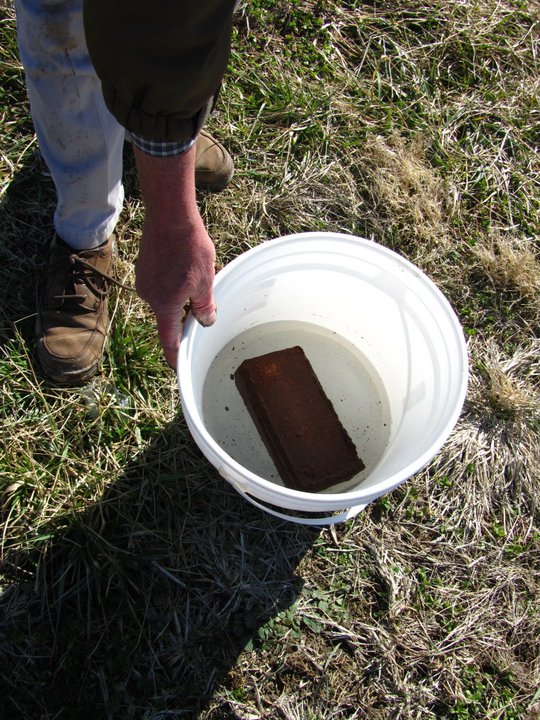
If your tree could talk, it would ask for a well-drained, fertile location with plenty of sunlight. While a full day’s sun is great, trees can still thrive and produce on a half-day’s light; and most trees are forgiving of imperfect soil conditions. If your ground is a little heavy, consider using our Coco-Fiber Potting Medium. Just drop the “brick” into 1 1/3 gallons of warm/hot water, 30 minutes before planting. When refilling the hole, work the fiber into the soil and finish planting. This will give the root system air and allow for water absorption as the roots develop.

…..…..

2.  Digging the Hole

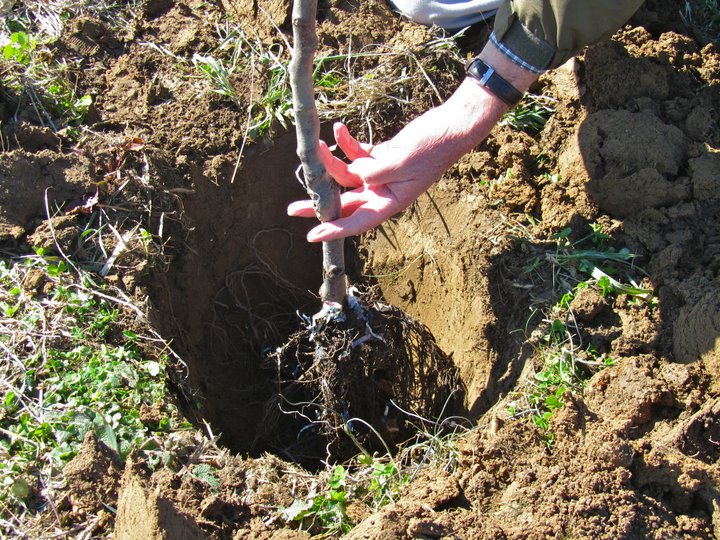
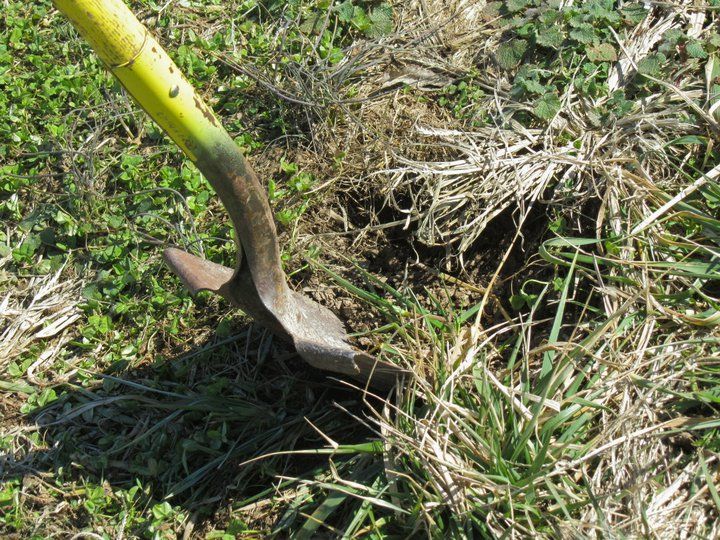
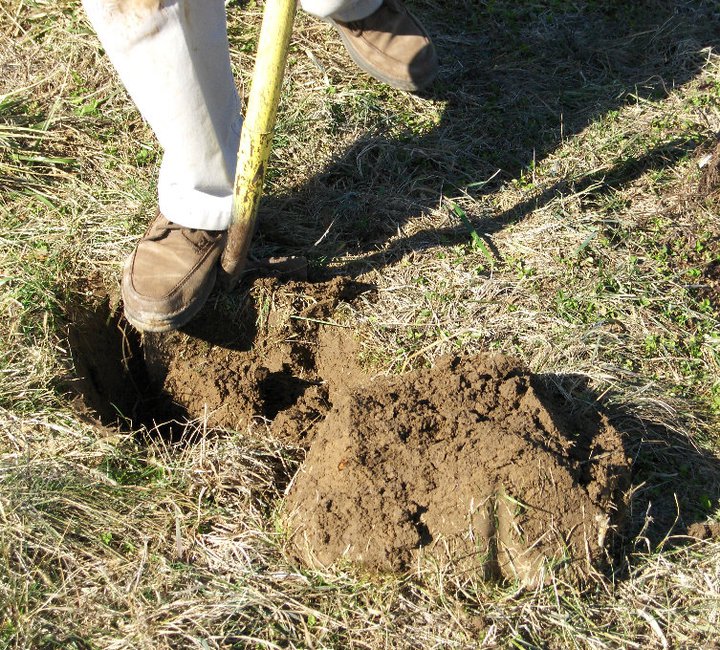
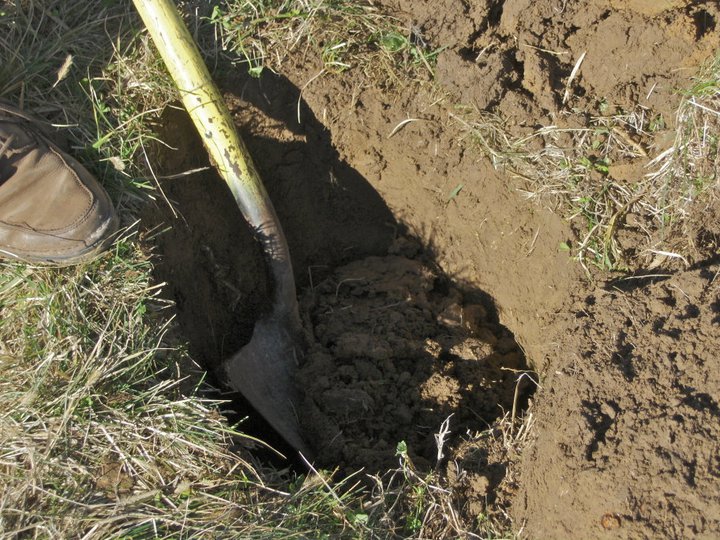
When digging the hole, a good rule of thumb is to remove a space nearly twice the width and depth of the roots. You don’t want the roots cramped or circled. The area you loosen is the area the roots will quickly grow into to anchor and sustain the tree’s top. This simple task helps determine both how good the foundation will be years later and how well the plant utilizes two much-needed ingredients: air and water.
3.  Planting the Tree

The Soil

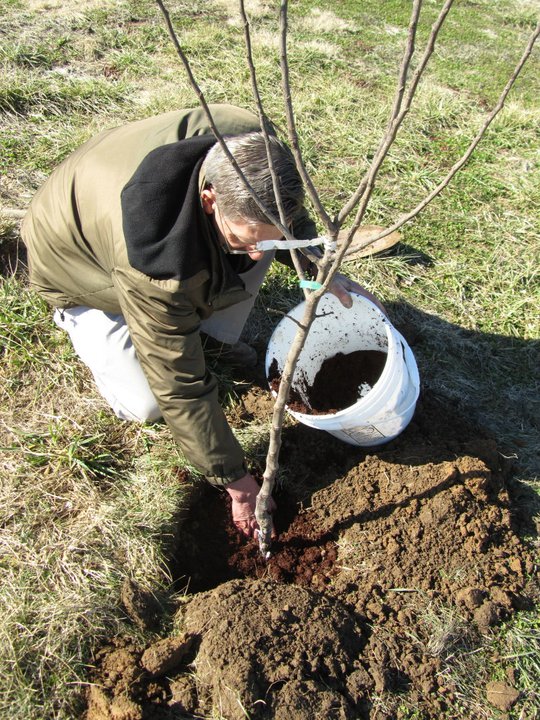
You know the soil you dug up first, right underneath the grass? When refilling your planting hole, it’s always best to place that soil in first. It’s usually more fertile, as well as more porous, and when placed down near the roots, it will help the tree grow better. The remaining soil (from the bottom of the dug hole) is heavier and works well when mixed with the Coco-Fiber Potting Medium.  From top to bottom, work the soil with your hands to avoid large clods that create air pockets.
…..…..

Graft Placement

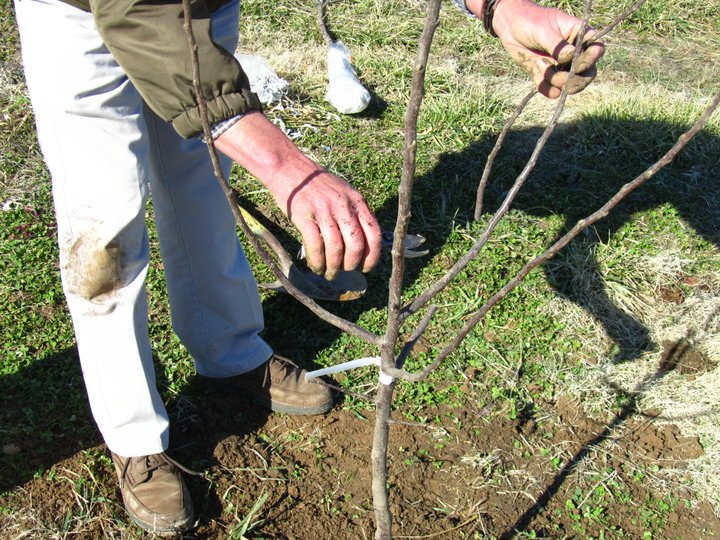
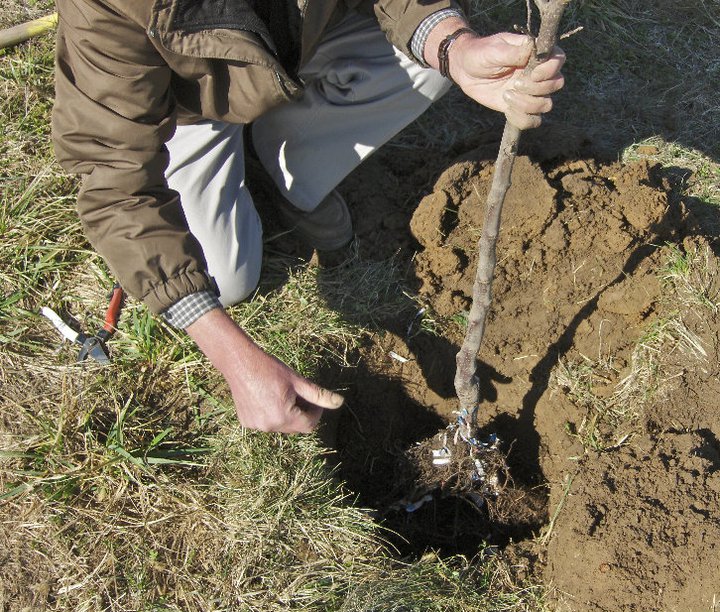
When you refill your planting hole, hold the tree up a bit to allow loose soil to fall beneath, as well as around the sides of, the roots.  Center its position so there is adequate space on all four sides for the root system to grow out.  If you are planting a dwarf or semi-dwarf apple tree, hold the bud union up above the refill line.  If given the opportunity, grafted apple trees will self-root; if the variety self-roots, you’ll lose the size-restrictive nature of the rootstock. (Did you know the rootstock is responsible for the mature size of your tree, i.e. dwarf, semi-dwarf, standard? We don’t want to lose that sizing—it would definitely throw a rock in your long-term plan!)

Finishing Touches

Through the process, keep the tree straight (perpendicular) and upon finishing, tamp the tree in with your foot to remove air spaces and seal it in. If the tree is planted on a slope, create a slight berm on the lower side to utilize water throughout the summer.  If it’s not pre-pruned before you plant it, be sure to prune your tree, and water it well.
 

Dear Friend,

There are few things in life that have the sustainability and bring the same satisfaction as planting a fruit tree.  The years following will be spent measuring the tree’s progress and reaping its rewards. That’s your “10-year” vision. Yep! I saw the end before I began!  Did you?

- Elmer

Topics → Planting & Growing, Tips

52 comments on “Fruit Tree Care: Planting Fruit Trees

  1. John S.Henchey on said:

    Just curious if there is any information available on development time for fruit trees. Example would be what stage of development shoud be expected after the first second third year etc. How long after a tree is planted should we look forward to the first fruit?

    • Meg on said:

      John, different fruit trees will bear at different ages, with apples/pears being the earliest (say, 2-3 years after planting) & cherries being the late bunch (up to 7 years after planting). Which trees are you waiting on? Pruning, proper pollination, bees, and adequate sunlight are your best bets for the earliest harvests. :)

  2. Nancy Kopchala on said:

    I not only saw the end I planned the end.
    My motto “Plan your work and work your plan”

  3. Debra Winright on said:

    I am going to plant a Japanese Weeping Cherry Tree within a week or so,should we remove the burlap bag that is around the root bottom before we plant it in the ground?

    • Brenda on said:

      Hi Debra! Yes, I would definitely recommend removing the burlap from the roots of your tree. Removing the burlap will give the roots the growing and breathing room they need. In addition, burlap is non-biodegradable.
      I hope this helps!

  4. johnmayatte on said:

    i bought two peach trees from you all last years, one is doing ok, the other is bare with nobuds, it looks like it was attacked by bugs, they are 25ft apart. JOHN MAYATTE

    • Brenda on said:

      Hi John! I’m sorry to hear about your peach tree. I would recommend our Bonide Fruit Tree Spray for insect and disease control on your peach tree. You may wish to spray both trees as a preventative measure.
      I hope this is helpful!

  5. Robert A. Forman on said:

    i Have been buying your trees for 40 plus years never had a problem.

    • Meg on said:

      That is so encouraging to hear, Robert. :) Thank you. Do/did you have any trees that were “favorites” of yours?

  6. Eric on said:

    Just got my order of trees from you guys. I’m in Zone 6. Do they need to be hardened off before planting or can I open the box and plant them right away? Forecast for next seven days has highs in the 40′s-50′s and lows in the 30′s to 20′s.

    • Meg on said:

      You can plant them asap, Eric! :) The trees are dormant, and this weather is perfect for transplanting. Which trees are you planting?

      • Eric on said:

        Great- it will be done tomorrow. I got two apples (semi dwarf) to replace a huge standard that keeled over this winter. I couldn’t resist so I had to get a peach and a cherry as well.

        • Meg on said:

          Excellent choices! You should get about the same size harvest on those semi-dwarfs as you got on your standard. :) Is your cherry tree sweet or a pie cherry? Be sure to plant that one in well-drained soil, cherry trees do NOT like standing water. They’re high maintenance like that. ;)

  7. Susan Rogers on said:

    Can you give some quick general tips for spring pruning of fruit trees, other than eliminate crossed branches and open up the center for light and air? I have 7 semi-dwarfs from you: 3 apple and 1 each of pear, plum, peach, and cherry. Two apple trees are in their 3rd spring and the others were all planted last spring. Thank you.

  8. Joan Romano on said:

    I bought a cherry & a blueberry tree form you last year. The cherry tree I planted in the ground & the bluebrry I planted in an over size pot 24 inches circumference. When can I expect fruit on them?

    • Brenda on said:

      Hi Joan! Blueberries typically take 2-3 years to bear fruit, while cherry trees can take 4-7 years before they bear fruit. I hope they grow well for you!

  9. Angela on said:

    I ordered 2 semi-dwarf apple, 1 dwarf peach and one semi-dwarf cherry tree to arrive in a few weeks. I was wondering how close the apple trees need to be to eachother for cross polination. Also, how far apart should all the trees be from eachother? Thanks!

    • Brenda on said:

      Angela, the apple trees can be as far apart as one-quarter mile and still achieve pollination. I would allow 15-18 feet between the fruit trees to allow for their spread at maturity. Happy Planting!

  10. Eric Kues on said:

    I just recieved 4 apple trees and two peach trees from Stark Bros. yesterday and they look great. The only problem is that yesterday we also got around two inches of rain and about an inch of snow. Now everything is just mud. How long can I wait to plant them, or is there a good way to plant them now?
    Thanks.

    • Brenda on said:

      Eric, happy to hear you’re pleased with your new trees! The trees are dormant so they can be planted as long as you can dig and the temperature is above freezing. I would not recommend planting in holes that have standing water as this could lead to root rot. Your trees can be kept in the box in an unheated shed or garage for up to 2 weeks. Be sure to keep the roots moist. I hope this helps! :-)

  11. Pingback: A Perfect Shade of Tree: the Hybrid Willow | Growing with Stark Bro's

  12. Jessica Dow on said:

    Hello! I bought 4 semi dwarf Honeycrisp apple trees, a GoldCot apricot and a Giant Hardy Asian Pear Tree a couple of months ago. Do I need to buy additional trees for cross pollination purposes?

  13. Earlene Lockhart on said:

    I pruned my Oriental Asian pear tree purchased from Stark Bros putting the small ones in flower pots for winter, they are growing and have new buds coming out. Do I need to have another brand pear tree for cross pollination . The original tree is self pollinating.
    It is 2-N-1 self pollinating Asian pear tree. The sprigs I planted are doing great.

    • Sarah on said:

      Hi Earlene! Propagating your own trees is unlawful for patented varieties, but to answer your pollination question: The 2-N-1 tree is technically “self-pollinating” because it has two varieties grafted onto one tree to pollinate one another. :)

  14. Steve on said:

    I purchased a Methley Plum Dwarf Supreme a couple of years ago, pruning as advised on your website. It’s quite large and nicely shaped and we eagerly anticipated a nice first crop this year. Unfortunately, it is producing very few blossoms, as the leaves are now coming on. The plant manual indicated you can usually withhold fertilizers until your trees begin bearing fruit (about 2-4 years), so I did not fertize this spring. The tree looks heathy; it just hardly any blossoms. Note: we had a mild winter, no hard freeze, so the tree dropped leaves late and only about a month before sping and buds began to appear. Is there anything you can suggest that would help encourge increased production of spring blossoms?

    • Sarah on said:

      Hey there, Steve! The plum trees actually take about 3-6 years before they start producing (usually closer to 3 years with a dwarf-sized tree, depending on the environment). This year, and this being its first attempt at a fruit crop, it is not uncommon that your tree hasn’t attempted to put on more than a few blooms. It is preferable to the tree stressing over more than it can handle. ;)

      I wouldn’t worry about the small amount of blooms that have formed this year, especially if they become pollinated and you get fruit. Since you didn’t apply fertilizer this spring, it will increase your tree’s chances at more flower production next year (rather than green/vegetative growth that nitrogen in the fertilizer encourages). I hope this helps!

  15. LT on said:

    Question really; Can a walnut tree pollinate with a pecan tree?

    • Sarah on said:

      Hi LT! The general rule to follow is to stay within the same type of tree for proper pollination (walnut with another variety walnut, pecan with another variety pecan, almond with another variety almond, etc.) — while there are exceptions to this (like how the Stark® Bountiful™ Butternut is used as a pollinator for
      Westfield Heartnut) walnut trees don’t pollinate pecan trees.

      Fortunately, there are many varieties of walnut and pecan that are self-pollinating, so if you only have room for one of each, I would suggest opting for one of the self-pollinating varieties. :)

  16. mark blosser on said:

    I have had many of my new stark apple trees die over the winter, down to the root stock. the root stock lives but the tree dies.stark has replaced the trees sometimes twice they all failed . they are all dwarf with no inner stock graft. all the dwarf i ordered before had inner stock graft those thees grow and bear great. I have 50 trees in my orchard , No dieses in my orchard . I thought it might be winter kill. so i called my county extention agency, he said we have no trouble growing those varity of apples in our area. the ones that keep dying are little jewel,candy crisp, sweet sixteen,red fuji.some of them you replaced 3 times.the last replacements were dead the spring of 2011, i replaced those trees with trees from another company and this spring they were alive.I have no clue as to what caused this problem or has any one else . thats why I am contacting you maybe you can shed light to this problem. ps I live in zone 5 Bruceton Mills W.V.

    • Sarah on said:

      Mark, when you contacted your extension agent did you have someone come examine the trees that keep dying so that you could get an idea of what keeps going wrong? It is difficult to advise you further when the cause is still unknown. What we know is that the trees have died from the top down.

      Since we can’t physically be there to examine the trees or the location to determine a cause, we recommend having a local expert provide this service in person. We also encourage you to provide us with photos of the trees that are being problematic, to give us a chance to examine them or their planting sites for any potential issues. If you happen to have helpful photos after this time, please send them to us at info@starkbros.com. :)

      After so many replacements and no success, if you have managed to find a nursery stock supplier whose product grows for you, I encourage you to stick with them. We want you to be able to have trees that grow and produce for you more than anything! :)

  17. patrick on said:

    Tomorrow I am preparing my holes for planting in anticipation of the delivery of 10 of your finest apple and four each of your pear, peach,plum and cherry trees! Much research has gone into the selection for each”brand” of all species to ensure my family and myself will enjoy fresh fruit from early summer untill late fall… even winter. We are looking foward to our trees producing inthe next few years… and future orders.

    Thank you for this very informative site.

    • Sarah on said:

      It sounds like you are well-prepared for planting and growing your own fruit trees, Patrick! We look forward to hearing about your progress with your new trees as they grow. :)

  18. gary haggard on said:

    i just planted 4 trees and i was questioning if i should spray with dormant oil for the winter

    • Sarah on said:

      We always insist reading the labels on the sprays you are about to use as a guide, Gary. As long as the conditions (temperatures, weather, trees, etc.) match what the spray recommends, you should certainly be able to use it while your trees are dormant!

  19. Tom Jones on said:

    My question has to do with fruit trees that i have purchased from someone other than Stark. I have just received 2 apples and 4 blueberries from you. While looking up the Sweethart Blueberries on another site, it says that they are for zones 4-8. I live in close to 9 zip 34491. Did i goof on the zone here with your site?
    other question is i have from seed, 2 Sugar Apple, how long till they produce here in my zone 9? and then Sapadilla (sp) how long if you know about them? thanks

    Tom Jones
    zone 9

    • Sarah on said:

      Hi Tom! The recommended hardiness zones are exactly that: recommended. I know some people who take that as a challenge, to intentionally grow outside of these zones, and hope for the best. A lot of the time the plants and trees struggle as a result.

      We have you listed as zone 8B/9A — so you’re on the cooler size of a zone 9. You might not have to be too overly concerned growing this blueberry there. If you want to play it on the safe side, what you might want to do is plant the Sweetheart Blueberry it in a container (many people prefer a container that is 12″ deep, usually 5-gallon sized) so that you may move it into an area with filtered sunlight during the hottest temperatures of the season. You may also still choose to plant the blueberry plant in the ground and construct a shade-cloth cover for the same effect.

      As for your apple question, it’s really difficult to judge how a seed-grown fruit tree will act. The fruiting time can vary between one seedling apple tree and the other, even if their seeds came from the same piece of fruit originally. The seed-grown trees may not bear worthwhile fruit at all, or they may simply take many years to become fruitful. Seedling trees aren’t backed by science or research like grafted varieties are, so along with not guaranteeing the fruit characteristics will be similar to the fruit the seeds came from, the bloom times, ripening times, or fruiting maturity may be unpredictable.

      I wouldn’t feel confident trying to advise on Sapadilla since we don’t grow or sell any Caribbean fruit trees here in Missouri, and I wouldn’t have a resource for expert advice. If you know any local growers who might be more familiar with that fruit’s habits, I think that would be an ideal place to find out more info on what to expect. Or you can try to get in touch with your local county Extension Service here: http://www.csrees.usda.gov/Extension/

      I hope this helps! :)

  20. Ellen on said:

    I have just ordered 2 apple trees from you, a Cox Orange Pippin and a Golden Delicious. I have never grown apples before, and am very excited to try. Both the trees are semi-dwarf.
    My question regards my soil. I live in a lake district with extremely sandy conditions not far below the surface. How will my trees adapt to this? Is there anything I can do to help them in their first year or two? (My neighbor had a very old and neglected apple tree that he unfortunately took down a few years back that was still going gangbusters in this soil, so I am hopeful) My other non-fruit trees all do very well.

    • Sarah on said:

      Hi Ellen! Your neighbor’s success growing their apple tree could mean good news for you; however, soil changes all the time and one area can greatly differ from another even if it is in close proximity. For soil-related questions, your best resource for accurate information would be your local county Extension (find yours here: http://www.csrees.usda.gov/Extension/). These experts, local to and familiar with your area, will be able to run a soil test (for nutrient deficiencies and other concerns) and advise you on what is best for your trees.

      I can tell you that, if your soil composition is sandy loam, it is excellent for growing most fruit trees, since it tends to drain well and roots have an easy time growing in it. This is different from heavy clay, for example, which tends to hold water and can cause root-system health issues. Heavy sand could drain too well so that you’re watching the water needs of your new trees more frequently to avoid a drought-like condition. A representative from your Extension should be able to identify the type of soil you have there and give you advice on amending it if it is needed. :)

  21. zack collins on said:

    I have ordered a few apple trees for my yard here in kentucky. I plan on moving in a few years so I planned on planting them in old whiskey barrell halves in hopes f bringing tem along whenever I do move. I was wondering if you could give me any info on if they may need to be moved indoors during the winter months. I’m hoping they wouldn’t. Those are pretty big barrells. thanks

    • Sarah on said:

      Those barrels can get very heavy once the soil and the weight of the tree all adds up! As long as the varieties you planted were suitable for your zone (and most apple trees are, for Kentucky), then you’re in luck, Zack — you won’t need to worry about moving them indoors for the winter. That method applies to trees that are not hardy enough for winter temperatures like Citrus, Figs, and Asian Persimmons, in certain areas. Bringing those indoors protects them from winter elements.

      Apple trees naturally tend to be more on the cold-hardy side, so, as long as you keep the soil in those barrels from drying out (frequent watering isn’t necessary, but dry soil leaves roots prone to cold injury), and add a layer of mulch over the top of the soil in the barrels, your apple trees should be set for winter!

  22. Amy on said:

    I planted a Georgia Belle peach tree 3 years ago. Last year, it was loaded with peaches. I made the mistake of not thinning out the fruit enough. The main vertical branch split because of the weight. I taped the branch back together hoping it will heal over the winter. I have removed the tape this spring and the branch seems like the sap may be healing. Can I clamp the branch to give it support this season, or is it best to cut it off? My main concern about cutting this branch is that it is the main vertical branch. Or do I have to cut my losses and cut down the whole tree?

    • Sarah on said:

      Hi, Amy! The kind of damage this limb suffered is one of the main reasons we suggest to thin the fruit. This split may leave the rest of the tree open to disease/infection, so your best option would be to prune off the damaged limb.

      There is no reason to cut down the whole tree. Peach trees actually do better if they have an open, vase-shape, structure like what is described in our blog post here: http://www.starkbros.com/blog/successful-tree-pruning/ — so it doesn’t need a main leader/limb to grow well.

      We also have a video on pruning to a vase shape here: http://www.youtube.com/watch?v=4WXqEObS8Iw

  23. Leila on said:

    Hi there,

    We’re thinking about buying one of your semi dwarf HoneyCrisp trees. We’re new to gardening and have been doing some internet research to get ourselves somewhat ready for a purchase and planting. Would a crabapple be a good pollinator? Do you carry crabapples? Or would you recommend another tree? How much space between the two shoud we account for (these will be in our backyard, we have about 30′ to work with in the area we’d like them)?

    We are in Northeast Massachusetts. How long does shipping to our area take? Your site is great and very imformative!
    Thanks!

    • Sarah on said:

      Hi Leila! We have recommended pollinators listed for varieties that require one — check out our recommendations for the Honeycrisp™ apple tree here: http://www.starkbros.com/products/fruit-trees/apple-trees/honeycrisp-apple

      A crabapple tree will surely work as a pollinator, too! We offer crabapple trees as well, and you can find those here: http://www.starkbros.com/tags/crabapple-trees

      Our crabapples are available as semi-dwarf sized trees, and you were already interested in a semi-dwarf Honeycrisp™, so it’s useful to know these trees grow 12-15 feet tall and wide, so they will need 12-15 feet of space between planting holes. It sounds like the space available is just perfect for these apple trees!

      Since we’re already shipping to your location this spring (we begin shipping there around mid-March), we usually estimate 7-10 business days from when you place your order to when you receive it by mail.

  24. James on said:

    I purchased a cherry tree last fall and planted it. This spring it is producing leaves nicely. The problem is, we are moving and I would like to take the tree with me. It is only across town so the zone isn’t different. What is the best way of moving the tree.

    • Sarah on said:

      The best time to move the tree would be when it’s dormant, which happens after it loses all of its leaves in the late fall/winter/early spring before it leafs out again. I’m not sure when you intend to move, or how likely it is that you can wait for the tree to go dormant before trying to transplant it, but the dormant state helps to reduce transplant shock as much as possible.

      As for getting your cherry tree from one location to another, the important thing is to keep as much of the root system intact as possible. The most essential roots are the fine, hairlike, feeder roots that are easily damaged or lost when things are disturbed. We recommend contacting a local licensed tree-care professional to assist you with the transition if it is cost-effective. They will be able to help make the move as smooth as possible for your young cherry tree. :)

  25. john thornton on said:

    I am a beginner in the fruit growing game. I was hoping you could give me some advice on selecting the type of trees i should begin with, how many,type for taste and quality, apples ,pears plums and peaches, i believe i am in zone five Dayton, Ohio

    • Sarah on said:

      Certainly, John — The best piece of advice I can give you is to first consider growing fruit trees that produce fruit you’ll like to eat! No sense putting in the effort for a fruit you’re not a big fan of. ;) Then, determine if the trees you’re interested in grow well in your zone. Some of the easiest-to-grow fruit trees, chosen by our experts here, are what we call our “Stark Picks”. You can browse all of our Stark Picks here: http://www.starkbros.com/tags/stark-picks

      While you’re there, enter your zip code where it asks for one so that you’re sure of your hardiness zone. Make sure that you select two different varieties for proper pollination (unless, of course, you opt for “self-pollinating” trees). We list recommended pollinators for each fruit tree variety, and we tell you if the trees are self-pollinating, in the descriptions. Apple trees and pear trees tend to need pollinators, grow similarly, and require similar care. Peach trees and most plum trees are self pollinating, grow similarly, and require similar care. This should help give you an idea of where to start, especially if you only want to give a couple types of fruit trees a try at first!

Leave a Reply

Your email address will not be published. Required fields are marked *

*

54,361 Spam Comments Blocked so far by Spam Free Wordpress

You may use these HTML tags and attributes: <a href="" title=""> <abbr title=""> <acronym title=""> <b> <blockquote cite=""> <cite> <code> <del datetime=""> <em> <i> <q cite=""> <strike> <strong>