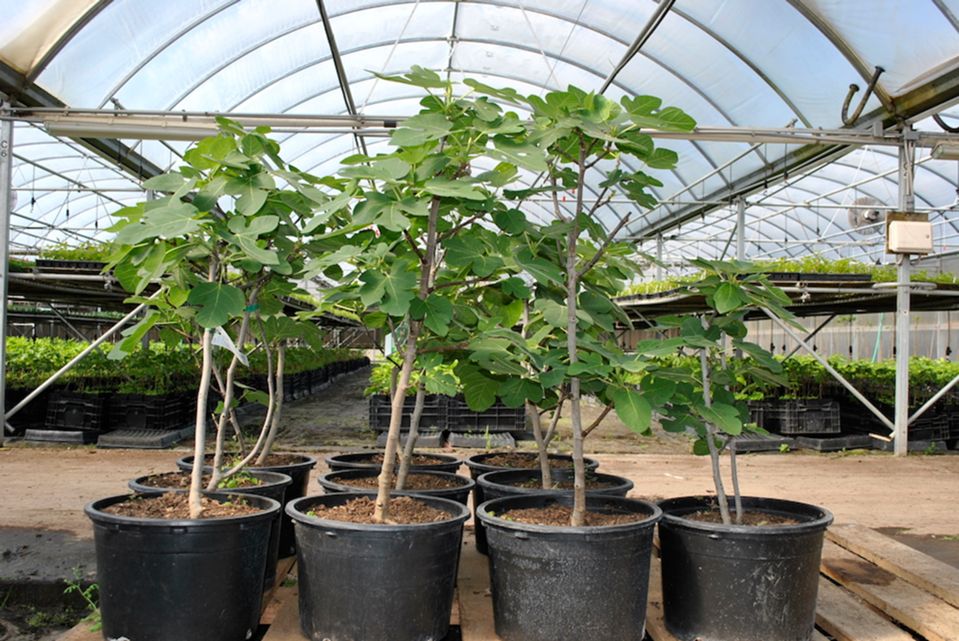
In part one of our series on growing fruit trees in containers, we gave you some helpful tips for getting started. In this article, part two of the series, we focus on what you need to do to take proper care of your potted fruit trees, so they can stay healthy, grow and thrive.
Watering Potted Trees
One of the number-one threats to a young potted tree is overwatering. Once the tree is planted in the container, it is very important to keep a close eye on it and only water when needed. While you want to avoid letting the soil dry out completely, daily watering may not be necessary. You should water when the soil is dry to the touch a couple inches below the surface. The sun may play a part in drying it out, so be aware of exposure to the location of your tree. This can vary if the tree is moved at different times of year.
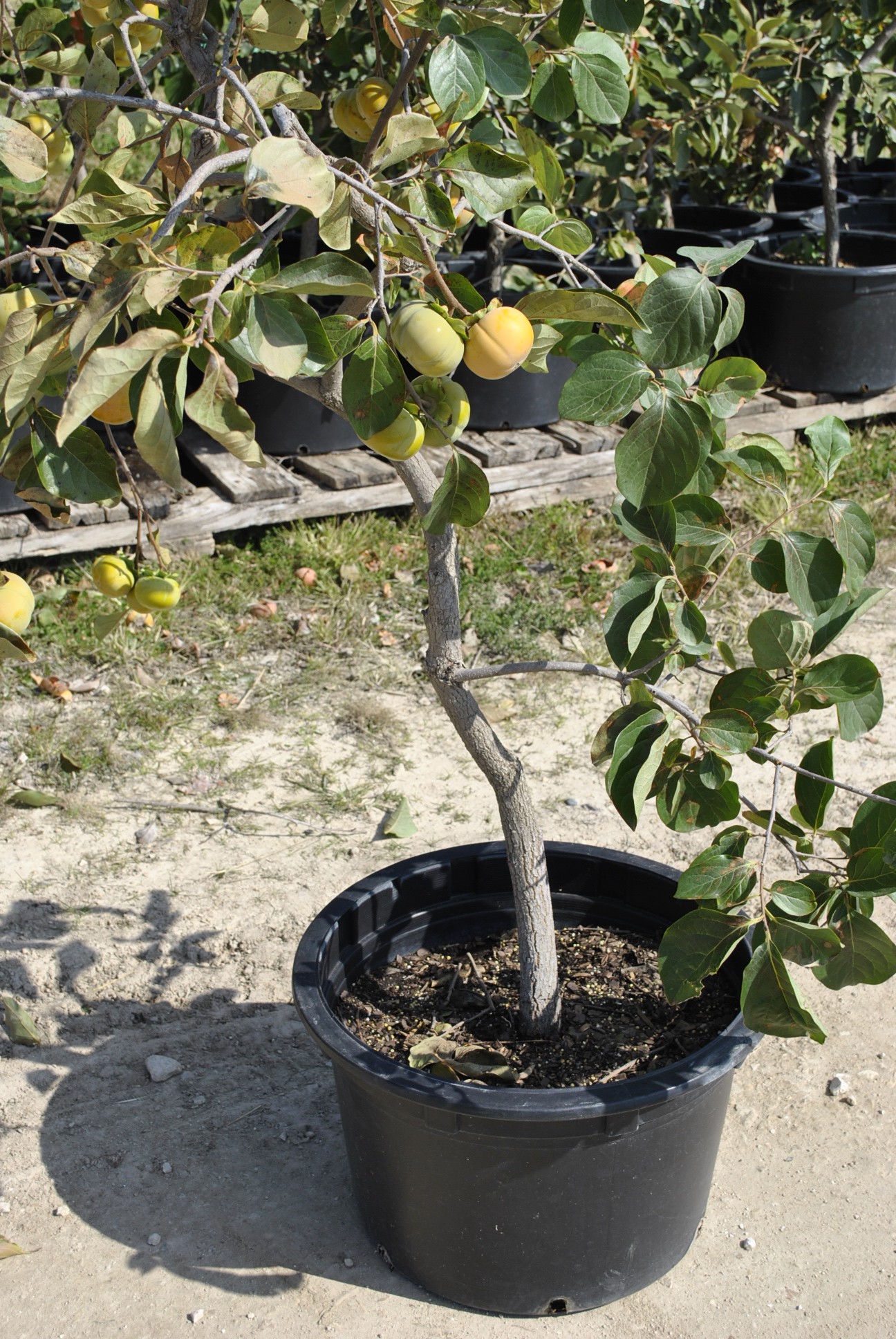
Note: Mature trees in containers outdoors, during the months where they are in full leaf (late spring, all through summer), can’t get enough water. You might notice that water appears to run through the roots and right out the bottom of the pot. Your mature, leafed-out trees would benefit from daily watering, until the temperatures cool off and the trees begin to harden off for the winter again.
Fertilizing Container Fruit Trees
Many potting soil mixes come with fertilizer included. If you are using a mix like that, then you will not need to fertilize additionally at planting time. However, you may choose to fertilize during the growing season. If you do, be sure to use a water-soluble fertilizer, like Stark® Tre-Pep®, so that the roots are able to absorb the nutrients successfully.
Winterizing Trees in Containers
Just like trees planted in your yard or anywhere outdoors, trees in containers benefit from winter care and protection. After your tree becomes dormant in the fall, there are a few important actions you should take:
For additional details or to learn more about winterizing, check out our article, Fruit Tree Care: Winterizing Your Plants. Be sure to check out winter-care information specifically for fig trees in our article, Fig Trees on Wheels!
When it comes down to it, growing fruit trees in containers can be just like growing them in a backyard. With the same kind of care, you can have your very own container orchard on your balcony, patio, sunroom or wherever you want!
I was hoping the article would include more useful information particularly detailed instructions on root pruning – how and when to do it. I have 8 potted fruit trees on my roof in NYC and am eager for detailed care instructions.
In some cases, videos are more helpful than words. You can get an idea of scoring the roots (making vertical cuts to break up circling roots) in our video on planting a Stark® EZ Start® Potted Tree here: http://www.youtube.com/watch?v=1N_72XJt5cw
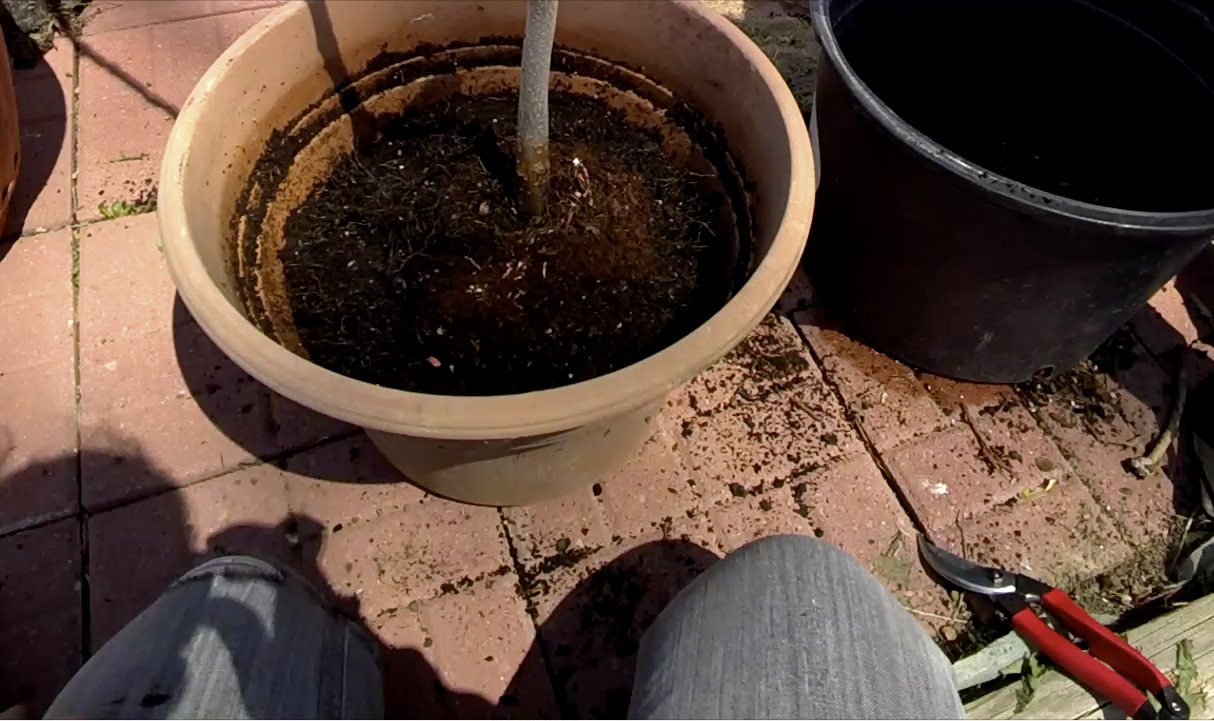
Every few years, after the tree has stopped growing taller in its container, it will become “rootbound”. This means the roots will continue to grow and could become densely tangled within the container walls, since it is not able to spread out like it would naturally. That is where root-pruning comes in.
1a. Initially select a container that is NOT uniquely shaped, so that the tree may be removed to allow roots to be pruned.
1b. If you already have a tree in an unusually-shaped container, (to avoid breaking the container to free your tree) simply and slowly hose away the soil so that the roots and the container remain intact and the tree is able to be removed.
2. Remove the tree from the container and trim the ends of the roots back by a couple inches at the most.
3. Take your knife and make vertical cuts around the circumference of the roots to break up any circling there.
4. Shake the roots free of any loose soil, and take this time to refresh your potting mix (out with the old, in with the new) — this avoids replacing your tree in old potting mix that may be depleted of nutrients or saturated with salts from fertilizers.
5. Re-pot your tree in the old container if you don’t want it to grow any more, or in a slightly larger container if you hope to encourage more growth.
Hopefully this helps.
Thank you!!
The two apple trees you sold me arrived good shape and have good roots and stock structure. Thanks, I will be back next year.
I am so glad to hear it, Louis! I can’t wait for your new apple trees to leaf out and develop (leaves, branches, grow taller, and thicker trunks!) for you this coming growing season. That’s when the real fun starts.
Are dwarf peach trees conducive to growing in containers?
They are, David! Even standard sized peach trees may be planted in containers, as they will become “dwarfed” by the roots being restricted in the container. Depending on the size of the container you choose (7- or 10-gallon pots versus, say, a larger — but less mobile — half whiskey-barrel) will allow for a different sized tree, but the tree will still grow and produce when it’s mature enough to!
I gave myself a meyer lemon tree in March, ept it outside all summer and moved it inside just before frost. It has been blooming profusely and developing what look to be lemons. Ho do I ensure the lemons make it to maturity?
A Meyer lemon tree was wonderful gift to yourself, Penney, I hope you remembered to thank you.
What you should do is pinch off a few of the blossoms that grow in clusters as well as the blossoms that have formed on spindly branches that might not support the weight of a fruit. That will help to keep your tree’s energy going to supporting fewer fruit to maturity and avoid any limbs breaking once the fruit grows in size.
Your tree may shed any fruit it is not able to support (fruit drop is not uncommon) but, other than that, make sure your lemon tree is getting enough sun or indoor light and doesn’t get too much (or too little) water, and you should expect to harvest your own Meyer lemons when they are ripe and yellow!
I have 4 apricot trees that I planted about 5 years ago; each tree is about 8+ feet high but has NEVER produced flowers. We live in Boerne, TX (area 8)…am afraid that the chill hours required (400 plus ?) are in excess of what our so-called South Texas winters have to offer. Any thoughts?
I shared your situation with our experts here, Don, and before I could mention your concern with chill hours, that is what they thought the issue might be. An apricot tree that has been with you in the ground for 5 years and is over 8 feet tall should have bloomed, even minimally, by its 3rd or 4th leaf. Chances are, these trees are not receiving the necessary cool temperatures (positive chill hours — below 45ºF) during the winter to contradict the warm winter days (negative chill hours — above 60ºF).
Your local county extension service would be a good resource to check with on this. They will be able to tell you if apricot trees have issues blooming and fruiting due to the lack of chill hours in your area. They will also be able to help you figure out what else might be causing this, in the event it is something other than lack of adequate chill hours (too much nitrogen, for example). You can find your Extension Service here: http://www.csrees.usda.gov/Extension/
I would like to ask about overwintering a Meyer Lemon tree. It currently has fruit on it, (that is ripening from spring blossoms) and just before I brought it in for the winter it bloomed and has loads of fruit forming. Do I pluck off most or all of the fruit or can I let it form thru the winter and set it back out in the spring…around mid March? Also should I get a grow light for it and how should I fertilize it? During the summer I mulched it with horse manure and watered it monthly with manure tea. Your help would be appreciated.
It’s delightful that you’re one of the many people growing their own Meyer lemon trees, Chuck! I would recommend breaking up any fruit clusters (select and leave just one fruit to develop further) and remove the fruit that may be forming on spindly weak branches that may not be able to support the fruit as it matures. This will help your tree support a smaller crop to a ripened point and help avoid premature fruit-drop (not an uncommon occurrence). You can certainly allow the fruit to remain on the tree while it is indoors and set it back out when the outside temperatures warm up again.
The grow light would definitely help keep your light-loving lemon tree happy, especially while it’s too cold outdoors to get direct sunlight. You should be able to continue using the manure tea as you have been to provide any soil nutrients while your tree is indoors. You can also choose to use a water-soluble fertilizer, or a slow-release fertilizer stake, if you would prefer.
I have a dwarf Contender peach (about two years in the ground) that is oozing sap at the base. What can or should I do about this, or is it fatal enough that I’m wasting time worrying about it?
Also, I have a Honeycrisp and a Jonagold apple tree— are they self-pollinating or do I need a pollinator or two?
It sounds like your Contender peach might have a borer issue, Ted. These pests get into the trunks (sometimes branches and twigs) of trees like peaches and cherries and the oozing sap is your tree’s reaction to their presence. If you look at the trunk, behind where the ooze is, you may see holes where these grubs are residing.
Borers can be manually removed — there are many methods, like poking a strong skinny wire into the holes and fish them out, for example — and we carry a preventative spray (Borer-Miner Killer) to avoid future infestations. You can also see if your local county extension service (find yours here: http://www.csrees.usda.gov/Extension/) can help you with removal or offer any further advice in your situation.
I’m getting an Owari Satsuma tree for Christmas and plan on container growing it and would like any advice from you.
Hi Thomas! Since you came here for expert advice, and we don’t grow the Owari Satsuma tree, I would like to provide you with the following list of links from sources that are more experienced with the tree you are going to grow in a container. I hope it helps!
Growing Advice (from Texas): http://aggie-horticulture.tamu.edu/archives/parsons/fruit/satsuma.html
Overview: http://www.gardenguides.com/98687-satsuma-orange-tree-care.html
Step-by-step Guide for Growing in Containers: http://homeguides.sfgate.com/grow-satsuma-tangerines-pot-34219.html
I have three citrus trees (valencia orange, lime, tangerine) that are potted. They are in their second winter. I bring them in the house in the late fall and return them to the patio in the spring. They look like they are healthy. They have about doubled in size. Last summer they did have some yellowing of their leaves. Do citrus trees need be pruned? If so how much and when? The orange has had a couple of blooms. Should I defruit them the first time? And should they be fertilized each spring? I live in Missouri.
Thank you.
Your citrus trees sound pretty happy, Steve! Citrus trees are one of the few fruit trees that don’t really require regular pruning to encourage fruit production. The most you will need to prune off a citrus tree is damaged/dead/diseased limbs that are dead weight for the healthy parts of the tree to support. They should do well with a spring fertilizer application. Remember, since the trees are in pots, there isn’t anywhere for the salty remains of fertilizers to disperse to after the roots have taken in what they need, so it is in the benefit of the trees to receive some fresh potting mix every few years or so.
If you pinch the flowers their first year blooming, your citrus trees will be able to reserve their energy and use it for growing (as a tree) rather than trying to reproduce (develop fruit). It’s not mandatory to remove these flowers, by any means, so it’s up to you! Remember that, if your trees are blooming while they’re indoors, you will need to help pollinate the flowers. All you will have to do in this case is use a small paintbrush or cotton swab and collect the pollen from one flower and dab it onto the next. It may seem silly at first, but it’s exciting when the fruit starts to develop!
Wow, I’m so happy to have found these Q&A’s on container fruit trees and this has been very informative. I want a dwarf apricot tree since I’ve limited growing area but have plenty of sunny driveway. How do you know when you water too much? Do your trees come with a watering guide or is a moisture meter the best option?
I’m glad to hear this information has been helpful to you, Theresa! Since so many environmental factors need to be considered, the moisture meter would be a good way to stay on top of the moisture level of the soil around your apricot tree. As a general rule, young trees require about a gallon of water per week (this translates to about an inch of rainfall) during the growing season, as long as there hasn’t been any rainfall in that time. If your area receives adequate rain in that time, it wouldn’t be necessary for you to water your tree on top of that. It doesn’t have to be exact or perfect; trees are pretty forgiving — after all, they make it by themselves in nature!
There are signs to look for if your tree is overwatered, like yellowed leaves or even leaf drop (defoliation). If your soil is heavy clay or the location doesn’t drain sufficiently, your tree may experience water stress as well.
We highly recommended that you have your soil surveyed (by your local county extension service, or an affiliate they recommend) so that you know what to expect before you plant. They’re a great *local* connection to have as you grow your own fruit trees.
Dear sorry for my poor Ingles?
I have two fig trees,in containers that I bring then in to garage,in winter, no heat what should i do to them? till I bring them out im Spring? thank you
Hello, Jack! I understand you perfectly.
All you have to do is make sure the roots and soil don’t become dry (water them a little bit once in a while), and try to keep the trees away from any sunlight so they don’t wake up early. When it’s spring, bring the fig trees out of the garage so they can wake up and grow!
I just purchased a lot of dwarf fruit trees for my indoor home. Do I need more than one tree to get fruit, if I am keeping them inside all the time and no one in my area has dwarf fruit trees?
Good question, Karen. The tree size is not important for fruit production, but pollination is. Unless your varieties are self-pollinating, you need *at least* two different varieties of each type of fruit tree to get fruit. As a general rule, you need to have pollinators of the same type to produce fruit; you can’t rely on an apple tree to pollinate your pear tree.
• Types of fruit trees: Apple, Pear, Plum, etc.
• Varieties of fruit trees: Granny Smith Apple, Golden Delicious Apple, Bartlett Pear, Moonglow Pear, Shiro Plum, Superior Plum.
Self-pollinating or not, if your trees are being grown exclusively indoors, you will need to be in charge of their pollination taking place. Outdoors, this is taken care of by birds, bees, wind, and other things that move pollen from flower to flower between trees. Indoors, it will be you with a cotton swab or a small paint brush, collecting pollen and moving it from flower to flower. From apple tree to apple tree, pear tree to pear tree, and so on.
To produce fruiting buds and quality fruit, you will also need lots of light (equivalent to 6 hours minimum daily sunlight that fruit trees need outdoors).
If you are simply moving your trees indoors (to a cool, dark place to maintain dormancy) during the winter, and moving them outdoors during the growing season, they will be pollinated by nature instead.
We have a blog post on fruit tree pollination, if you’d like to read more about it, here: http://www.starkbros.com/blog/the-importance-of-fruit-tree-pollination/
Hi
We have quite the big terrace in Brooklyn and we want to grow fruit trees in containers that can stay outside during the winter. There’s plentiful sun also. Which species do you recommend? Thanks!
Hi Rodrigo! Most fruit trees adapt well to being grown in a container, so it’s really up to you which fruit trees you hope to plant there. If they’re going to need to survive winters outdoors on your terrace in Brooklyn, just be sure that you’re selecting trees that are recommended for your zone. This is as simple as going to http://www.starkbros.com and entering your zip code where it asks for one. That way, a check-mark symbol will appear on the varieties that are recommended to be grown in your zone there.
If you’re going to move the fruit trees indoors during the colder times of year, you can even consider growing your own dwarf citrus trees (lemon, key lime, orange, tangerine, etc.).
Keep in mind, while there are self-pollinating varieties, most fruit trees need another variety (examples: Granny Smith, Fuji, Honeycrisp) within the same type of tree (example: apple tree) for pollination to eventually produce fruit.
My meyer lemon seems to be quite happy in my sunny window except for having scale that I’m keeping after. I’ve had lots of blooms and it’s producing a goodly number of lemons (I’ve been taking some off). here is my question: when do the lemons actually turn yellow? A couple of the lemons have been on the tree for a couple months now, but are a lovely bright green. This is my first citrus tree hence my somewhat silly questions. Thanks for your help.
Your question is completely understandable, Penney! I had the same concern when I saw my first fruit on my Meyer lemon tree. It turns out, citrus can be very slow to ripen, sometimes taking up to 18 months (from initial fruit set to ripening) to reach that ideal yellow-ripe state. They can also develop new fruiting buds and bloom while the last set of fruit is still ripening on the tree.
Light exposure definitely helps with fruit development. My tree had its first fruit indoors during the winter here in Missouri, but as soon as it got some actual sunlight, development really started picking up.
I live in Alaska where we are plagued by awful commercial fruit during the winter months. I’m wondering if there is any way to have fruit trees indoors (a heated garage with grow lamps or a greenhouse) that will produce during the winter to offset our lack of decent fruit at local grocery stores. Thanks in advance!
Most fruit trees require a dormancy period for fruit production, which is triggered by cold (winter) temperatures, so it wouldn’t really be beneficial to try to keep fruit trees awake to cover fresh-fruit gaps. Here’s the good news, Sarah: many types of fruit, like apples, pears, peaches, etc. are able to be harvested at their proper times of year and stored for use later. You may can them, turn them into sauces and preserves, pickle them… there are many options (and many resources online how to do these things, easily)! You may also choose to slice and freeze them if you are hoping to enjoy the fresh, homegrown, taste even in the off season.
I was able to enjoy slices of peach in the winter time from my aunt’s white peach tree that happened to overproduce the summer before. It was a delightful treat! All we did was slice the extra fruit and store those slices in vacuum-sealed bags in the freezer (with the date written on them of course!). We allowed them to thaw before eating and they were delightful!