“Why won’t my tree bloom or bear fruit?”
This is a common and frustrating question for any grower. You’ve planted your fruit or nut tree. It’s growing. It’s living. But it’s not blooming or bearing fruit. While this can discourage a grower to the point of wanting to chop the tree down, you should go for the facts, not the axe! If your fruit (or nut) tree doesn’t bloom or bear, it isn’t unusual, and it can happen for a number of reasons. In this article, we focus on some of the most common issues and how you can address them.
1. Tree Development
If your fruit or nut tree is still too young, it won’t go into fruit-production mode. When you receive your tree from Stark Bro’s, it will be around 2 years old and will still need a few years before reaching its fruiting maturity. Check out our article, How Many Years?, for more information about how long it takes for different trees to bear before deciding your tree has bearing problems.
2. Pollination
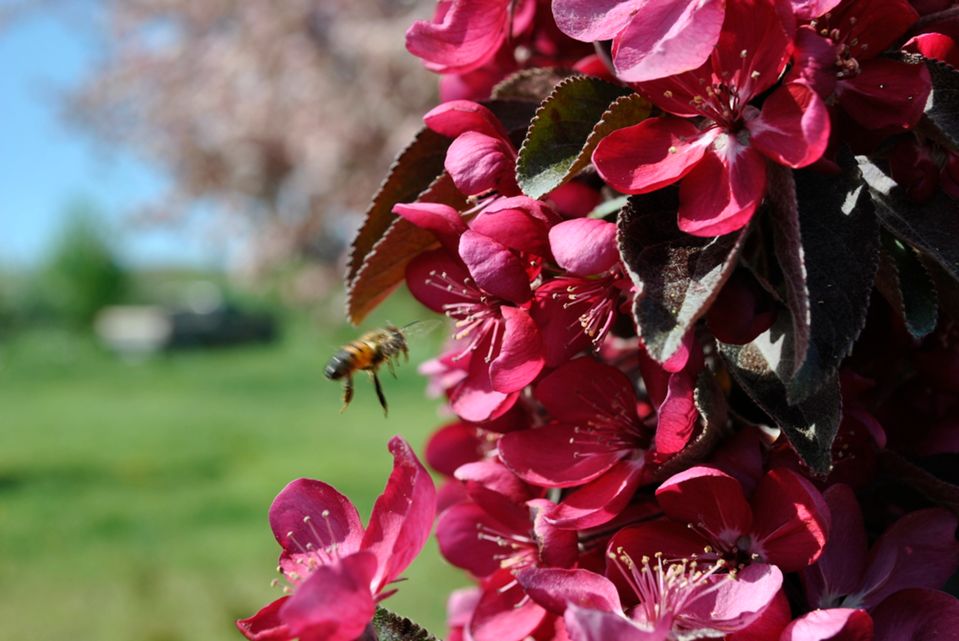
Fruit and nut trees require pollination to be able to set fruit. If your tree is not self-pollinating, it needs a compatible pollinator planted nearby. Also, pollination helpers like bees, birds and wind need to be adequately present. If your tree is missing these important elements, it may bloom profusely, but it will most likely never set fruit. Read The Importance of Fruit Tree Pollination to learn more.
3. Hardiness Zones
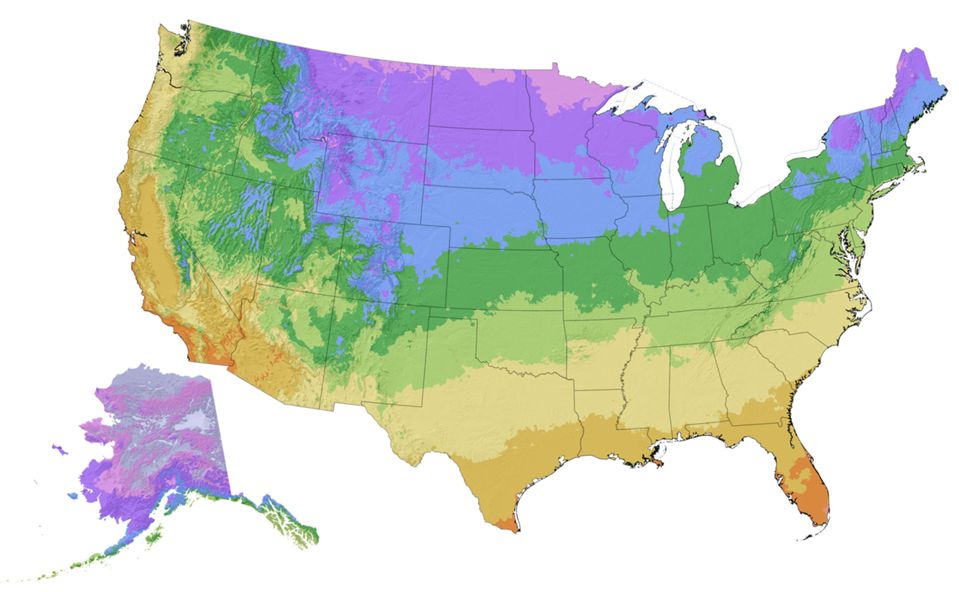
Each variety of trees has recommended hardiness zones for planting. You can find tips to help you find your hardiness zone by reading Fruit Tree Care: Planting in the Zone. Once you know what your zone is, you will be able to select fruit and nut trees that will grow in your area.
There are different things to consider when you plant in your zone:
4. Soil Conditions
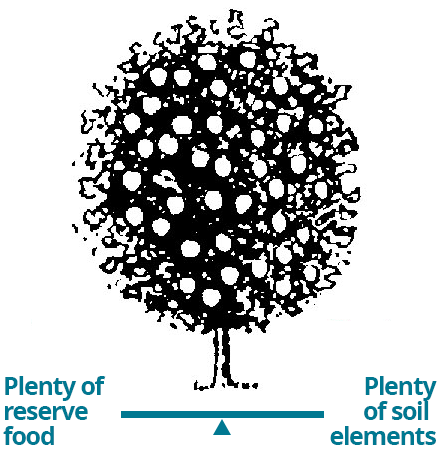
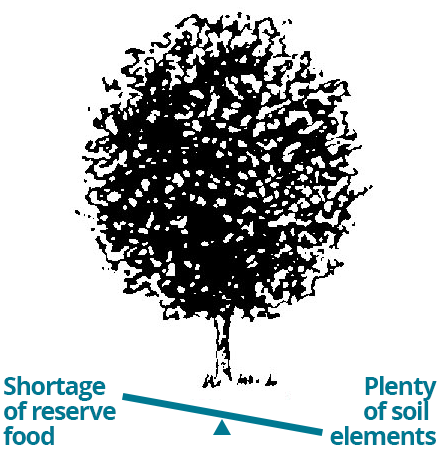
It is very important that your trees have the right balance of reserve food and soil elements. As you can see in the graphic, if this balance is off, it can have a negative impact on how your tree blooms or bears.
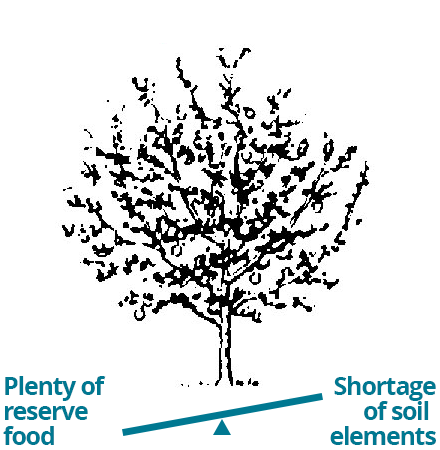
If a tree has plenty of reserve food but a shortage of soil elements, you may see a stunted crop of undersized, poor-quality fruit. You might even see no fruit at all. This can happen if your tree has tried to overbear, which may cause a tree to drop its fruit prematurely. It may also happen if your tree has experienced foliage-depletion, which can be caused by stress, weather or other weakening factors like animals, pests or disease. Identifying the stress factor and treating it can help to remedy the problem. You can perform soil tests to find nutrient deficiencies. You should also consider a regular spray schedule to control pests and disease.
A tree can also have an excess of soil elements but not enough reserve food. The tree will appear to be healthy and lush during the growing season, but it will not bear fruit (even if it is mature) since, in most cases, the tree doesn’t bloom. This happens as a result of “over-feeding.” If the soil provides plenty of nutrients, like nitrogen (either naturally or by adding fertilizer), the tree puts on vigorous vegetative growth that will delay the growth of fruiting buds. You can remedy this problem by holding off on fertilizing, pruning the roots or scoring your trees.
Root pruning: Bring a spade or shovel out to the drip line of your trees. The drip line is where the tips of the branches are, but straight down on the ground. Take the spade or shovel and push it straight into the ground and pull it straight back out. Do not dig out any dirt. Move over a foot or two and repeat the process. You are essentially creating a dotted-line circle around your tree. That way, your tree should be encouraged to bloom during the next growing season.
Scoring: This has the same result as root pruning. When scoring your trees, bring a small knife (like a pocket-knife) out to your tree. Locate a spot low on the trunk and cut a single horizontal line into the bark, only halfway around the tree. Move up several inches and repeat this, but halfway around the other direction. Do not let these lines connect to one another. See the animated image as a reference for scoring the tree.

Demonstration of Tree-Scoring
5. Pruning
Regularly pruned trees are much more apt to produce quality fruit. Fruiting buds tend to form on limbs that have adequate air circulation and light infiltration, enabled by pruning. Learn about pruning tips and more in our article, Successful Tree Pruning.
You also have to make sure that you find the right balance for pruning. Heavy over-pruning can make a tree too vegetative, and under-pruning can contribute to overbearing and fruit drop.
6. Spacing
Fruit and nut trees that are planted too close to one another will compete for nutrients and light. If they are planted too close to buildings and other structures, they will have similar conflicts. Make sure you give your trees enough room to grow and flourish. For an easy-to-follow guide to tree-spacing, explore our article about Fruit Tree Sizes.
If you keep these instances in mind, then you will have a better understanding of why a fruit or nut tree does not bear. Nip a potential problem in the bud and exercise your patience (not your lumberjack-swing). Your trees will thank you!
Sarah grew up in sunny South Florida; but despite her ideal location for year-round gardening, her own growing adventures began when she transplanted to Missouri. Keen on research and analytics, Sarah is always expanding her garden knowledge; but the real challenge (and fun!) is her experiences– in the dirt. Sarah is the voice of Stark Bro’s on our social sites, where she communicates advice from the experts for everyone’s benefit. If you have a question or just feel like chatting, Sarah is your intelligent personal assistant who helps you grow your own! Connect with Sarah personally on Twitter, and say hi to her on Stark Bro’s Facebook, Google+, and Twitter.
Twin Meyer lemon trees in Cu pots. One blooms great withg fruit. The other (a Starks’s replacement) has never bloomed. It is green and tends to be gangley, I shape prune it and never bloomed. The other is smaller but great flowers and fruit. Treatment is the same as they are side to side. Indoors in winter here in Boise and out after frost is over. Finally ordered a 3rd last year and it is recovering from an enexpoed freeze with new growth so time will tell. I complained a couple of years ago and got the use this type of fertilizer speil. Still no flowers!!!
Hi Jim.
Potted citrus trees tend to do a lot of their vegetative growing until their roots meet the edge of their container. At this point, the tree will begin to bloom. Chances are, the lemon tree in question is not ready to begin blooming/fruiting yet.
On May 4, 2007 i planted a large potted (5 gallon) Stark Bartlett pear. The next year i got some pears.
Every year i get pears. Problem is it is only on 2 side lower branches. The tree has about 20 plus branches, but only the same two branches have pears every years.
I am getting tired of waiting for the other branches to put out pears. This year same branches. Every year i get about 10 pears. What is the problem.
The tree trunk is 3 inch in diameter and the tree is about 12-15 ft tall. Tree looks great, just only has blossoms on these 2 lower branches.
Just don’t understand why there is not blossoms on the rest of trees. I have been growing apples and pears for over 30 years. All other trees i grow produce lots of fruit.
This is first for me? Never had this problem before.
Just think over 20 branches and only 2 branches have blossoms.
Thanks
Rick Carter
Will be stopping in in June to buy some things
From Michigan
Hi Rick! I have to ask, do you prune this pear tree annually? Light helps a lot to encourage fruit production. If you could send us photos of your pear tree [to info@starkbros.com] so that we may get an idea of other environmental factors that could help us advise you, that would be great!
I have several apple trees that did not bloom this year. They are 4-5 year old trees. They all received moderate pruning as I seen fit early this spring. My question is, do I try root pruning, scoring and not fertilizing while the trees are at this age or is that recommended for older trees? If I can try these methods for my trees when do you recommend scoring, root pruning etc?? This spring/summer, fall, or next early spring? Thanks in advance for your reply
Good questions, Mark. Since apple trees can take up to 5 years before they begin to bear, I would hold off on trying to root prune or score your trees. These methods are intended for use on developed trees that are not bearing when they should be. Yours may simply need more time to develop and reach fruiting maturity.
Would you be able to send us photos of your trees? Depending on how developed your trees are (determined by the trunk) we will get an idea of what your trees should be doing at this point. Please send any photos to info@starkbros.com
What are the “soil elements” you mentioned?
Hey there Jay! The soil elements are the macro- and micronutrients that are naturally occurring in the soil or are added through fertilizers and other soil-conditioning additives.
For example: Nitrogen, Phosphates, and Potash found in most common fertilizers would be considered soil elements when they are feeding your tree.
Hi! Thank you for the article! What does scoring do to the tree to make it fruit? Just wondering, I have always thought damaging the trunk would hurt the tree. Thank you!
Great question, Elaine! Scoring disrupts the vascular system of a tree. As long as the scored lines don’t connect (connected lines would be similar to girdling the tree), scoring acts as a sort of “shock” that is not detrimental to a tree. It encourages the tree to want to bloom and reproduce rather than sit contentedly taking in plentiful nutrients.
How can you stop peaches and necterines from getting stone rot or whatever it is called where their is only the stone left on the tree?
Don, what you’re seeing left on the tree is most likely a mummified fruit. Do you spray your trees at all? We carry a Bonide® Citrus, Fruit & Nut Spray that is a great, and natural, control for many pests and diseases. We would also be happy to take a look at any photos if you have them so that we may see what you’re seeing affecting your peach and nectarine trees. You may send them to info@starkbros.com if you have any!
Hi, We have some apple, peach, and pear trees that are on their 3rd year, and doing beautifully – except for the Peach Tree leaf curl that the peach trees seem to have. They apparently got it last year as well, but we didn’t know what it was. I have done a little bit of reading around the web, but wanted to know what the best thing is to do about it.
Thank you so much for your time –
Kimberly Saufley
Hello, Kimberly.
Peach Leaf Curl is a bothersome fungal disease. One of the best methods of controlling it is with a dormant spray like Hi-Yield® Lime Sulfur Spray. The key here is timing so be sure to use it while your trees are still dormant.
You may also use something like Fung-Onil™ Fungicide to control this fungal disease starting in the fall and then again before the buds swell.
Thank you so much! I have another question! The apple trees that we purchased at the same time as our peach trees – 3 years ago this year. The peach trees looked like they were going to bear – then got the fungus. The apple and pear trees are only barely bearing… What should we do? – if anything? Waiting seems to be what we may need to do. We just want to make sure we are doing the pruning correctly and doing spreading the branches, and well, all the things you are supposed to do. =) Thank you!
Kimberly
Peach trees are one of the first to start producing fruit. Apple and pear trees, on the other hand, even at 3 years old, may still need more time to bear regularly so your instinct is right, Kimberly! Waiting is sometimes the hardest part about growing your own fruit trees, but it is definitely worth it.
As long as you’re pruning to remove damaged/diseased limbs and to keep your trees open for light and air circulation, you’re doing great! You will also want to prune back 1/3 of the new growth from that year so that the limbs are more sturdy and less lanky (especially in apples and pears — this lanky new growth may be susceptible to fireblight).
In the fall/winter/early spring while the trees are dormant and have no leaves, it is the best time to really take a look at the structure of your trees so that you can strategically prune what needs to go, for their benefit in the following growing season.
What is the definition of “Reserve Food” and “Soil Elements”. If there is a problem with these, how do you correct the problem.
Good question Royce!
Soil Elements are the naturally-occurring or added (fertilizer) macro- and micronutrients in your soil that your trees use as food. The tree feeds on these elements during the growing season and they, along with photosynthesis, feed the tree’s vegetative growth. Reserve Food is what the tree stores for itself over the winter to encourage development in the spring to bloom and bear fruit.
My trees are going into their second spring with any buds or ANY growth at all. They remain as sticks with roots. They seem alive and sturdy but not growing. They are peach, cherry and apple, purchased from stark bros an planted in the recommended fall period – when it was still quite cold. I recently planted 2 new apple trees and they are budding and growing.
How can I get those other trees going – I’ve fertilized, watered etc
Thx
Hi Steve. First, we want to make sure the trees that are not doing anything are actually still living. You can check by scratching a small spot on the bark with your thumbnail about halfway up the tree. You are looking for green beneath this scratch to let you know if they are still living.
If so, then the next thing we should check is the location: These trees should be getting full sun (at least 6-8 hours) without being shaded-out by taller trees, buildings, etc. They need to be in a well-drained spot. If they are planted in clay soil, their roots might struggle to break through the sides of their holes, which would make it difficult to grow. The soil there needs to be the proper pH for peach, cherry, and apple trees (they prefer a neutral type soil pH) — not too acidic.
Is the fertilizer you’ve used water-soluble? These tend to be more fast-acting and I would encourage continuing your regular applications (usually every 10 days or so depending on the label).
If you’ve been doing all of these things and they are planted in ideal locations, please send us photos of your trees in their environment so that we may get a better idea of what’s going on with them. You may send those photos to info@starkbros.com
I have two Black Tartarian cherry trees with a Mont Morency cherry tree very close by but I continue to only have only a few Tartarian cherries on the trees each year. The trees are healthy and growing but only produces about 5 cherries per tree.
Any Suggestions?
Robie Houser
Vale, NC
Hello Robie.
I’m not sure how closely they are planted but, if they are too close, the trees could be competing for nutrients and light.
Do the Montmorency and Black Tartarian trees have similar bloom times? The Black Tartarian is getting pollinated, but if it isn’t getting adequate pollination it won’t be able to produce a large fruit crop.
The other thing that comes to mind is that the Black Tartarian tree is not yet developed enough to produce a greater amount of fruit. In some cases, even if a tree has been in the ground for several years (about 4-7 years for a sweet cherry), if it hasn’t developed enough, it will still need more time to bear large fruiting crops.
If you’d like us to take a look, please send photos of your tree to info@starkbros.com — We would specifically like to see it in its environment, how closely it is planted to the others, and how big around its trunk is so that we can advise you further.
I have a dwarf orange tree that is about 3 – 4 years old. I planted it one year outside and it weathered the winter with quite a bit of freeze that was pruned back in the spring. Problem is, it does not blossom at all. Grows higher each year and winters perfectly even without cover this past year. I have not pruned it this year but will soon. I have it close to the house and think this is why it weathers so perfectly. I only have the one tree. Could that be the problem? I thought the first freeze had affected the grafted limbs, sending the tree back to its basic structure.
Hello, Dorothy! A fruit tree will still bloom even if it doesn’t have another pollinator around. The orange trees we carry are also self-pollinating. Heavy pruning may encourage more vegetative growth than fruiting so if you are pruning to keep the tree free of damaged/diseased limbs and open to light and air, you should be fine.
Even if frost damaged the original limbs, our Valencia Orange is propagated on its own rootstock so it would still be an orange tree growing.
In a potted scenario, citrus trees tend to bloom when their roots have reached the edges of the container. They put the energy into blooming and fruiting rather than growing. Your fruit tree may still be trying to grow more than bloom or fruit and may need more time to try to bear.
I’ve read a lot about how fruit trees require several years of growth before they will start bearing.
How many years will a fruit tree bear before it stops bearing?
Hi Don! That depends on the type of tree in question as well as the size. Speaking generally, a dwarf fruit tree can live and produce as many as 25 years while larger trees bear and produce for at least that long and often many, many years longer.
We hear from customers that have been growing our fruit trees (usually apples) for 30-40 years and they’re still bearing prolifically. A lot of it has to do with care, environment, and health of the trees how fruitful their lives are.
Can I grow and fruit cherry tree in Myrtle Beach,S.C.
Hi Walter.
We have you listed in a Zone 8A in our system so the only self-pollinating sweet cherry that should grow for you there is the Starkrimson® Sweet Cherry. If you have space for more than one tree we also have Starking® Hardy Giant™ Antique Sweet Cherry and Royalton™ Sweet Cherry but they are going to require two different varieties planted for cross pollination so that you’ll get fruit.
If you were interested in pie/sour cherries, you could also try Balaton® Pie Cherry or North Star Pie Cherry.
Note: Since you are on the higher end of the recommended zones for most of the cherry trees we offer, I strongly recommend checking with local growers/garden centers to see if they recommend giving cherry trees a try in your area. Often, even if a tree is recommended to survive in your zone, different environmental factors and microclimates may keep you from being successful in growing the tree or ever getting fruit from it.
Our Stark cherries, both self-pollinating and not, were planted in 2005. Beautiful spot for sun, good spacing on the trees, perfect soil conditions, good growth and vitality, pollinators in abundance, and on and on—yet we have no fruit.
We’ve pruned in alternating years, fertilized in alternating years, and done everything we know to do, but our trees are barren. I know it takes a few years to expect fruit, but the trees still are not producing anything. Not what we were hoping for.
I haven’t resorted to scoring yet, but I don’t know what else to do. Knowledgeable people who have examined the trees say they are in great shape.
Any ideas?
DLE, your cherries are most likely sweet cherries so it is not uncommon that they take as many as 7 years even to begin bearing. The ideal conditions will help them to be better prepared for their production years but it really comes down to the age and development of the trees. Sweet cherries require more time than other fruit trees to reach their fruiting maturity.
Next spring could be promising for fruit production since they will have met and surpassed the recommended time frame for healthy sweet cherry trees to begin bearing. If they still fail to bloom and fruit, your next step would be to consider scoring or root pruning your trees to encourage them to produce fruit the following growing season.
I have a number of differant apple trees, some cherries and peach also. I purchased all from Starks about 10 years ago, and paid attention to pollination issues. I have also done suggested pruning, but from year to year edible fruit “yield” is never great… I either get very little fruit, or lots of fruit (over production) that falls off. I was ready to try some root pruning, but then saw the article on “scoring”, which I had never heard of. The scoring method with a knife seems much quicker and easier than root pruning with a spade. Are there any advantages or disadvantages comparing “scoring” vs “root pruning”. Also, best time of year for scoring?
Scoring is simply an alternative to the root-pruning method, Alan.
They have the same effect. Scoring should be done before bud break in early spring for best results.
Note: please remember not to make the score cut all the way around the tree on the same level. This will “girdle” it and will be detrimental. Score halfway around the lower trunk and move up several inches to score halfway around on the opposite side.
thanks for the response – How “deep” are you supposed to cut into the tree on the two cuts? Just thru the bark (1/32″), past the bark (1/16″), or????
Just through the bark is fine, Alan.
You’re not trying to really “cut” the tree, just disrupt part of its vascular system (which is located just under the bark) a bit.
I have over 20 of your Apple Trees, some of which are over 8 years old. This spring I had 3 trees (Granny Smith) bud, but not break. They appear dead, but are still showing life (green) under the bark with no foliage. We had a mild winter in NC (Zone 5-6). Is there any possibility these trees will come back next year or are they lost? If lost any idea why?
Rick, this has been a most unusual year to be a fruit tree as well as a fruit tree grower, hasn’t it?
As long as the trees are still living (green under the bark) they should eventually put on new vegetative growth. To encourage this, if you aren’t already, we recommend applying a fertilizer to your trees, but no later than July. If they are fertilized beyond July, the trees will be forcing new growth when they should be going dormant in the fall/winter, and this can cause problems with freeze damage later on.
Hello,
Between the neighbor and me – we have 4 apple trees we bought from you 3 years ago – all are looking very healthy and good. I have picked all the buds off the trees since we planted them but yesterday (05 Sep 12), my daughter noticed a lone apple at the top of the UltraMac Tree – it is a perfect looking apple – small in size – bright in color (red) and looks very good to eat. I looked at the other branches and trees and found no other fruit on any of them. My question is – what do I have in store for next year with this tree or any of the other ones? I know your articles say about 2-5 years for the trees to bear fruit and I think I read once it starts to procude fruit it will pretty much stay at that height – it is about 7-8 ft tall. Can we expect more apples next year on all the trees or more apples just on this one tree? Thanks.
Good questions, David! If the apple trees you have planted are dwarf-sized trees, they should max out at 8-10 feet tall, semi-dwarf trees will be 12-15 feet tall, and standard trees can be anywhere from 18-25+ feet tall at maturity.
The tree might not grow while it has fruit set, since it will be putting energy into supporting that fruit, but if it has not yet reached its mature height, it will still continue to grow even if it has already reached a fruit-bearing maturity.
Since your UltraMac apple tree has started producing fruit, you can at least expect that same tree to produce again for you next year. You might want to leave some blooms on the trees to test this theory, and thin out any clusters of fruit that might grow. This will avoid the fruit crowding on your trees so you can get the maximum size and quality for your new homegrown apples!
We have a pear tree that is about 7 years old and is about 15′ high and very lush and round with beautiful leaves. It appears to be very healthy and does bear fruit. The fruit never grows beyond the size of an acorn but is shaped like a pear. Please advise. This tree was to be an anjou pear tree.
Hi Gloria, have you tried thinning the fruit on your pear tree when it begins to form? This may help the tree bring a smaller quantity of fruit to a larger size.
Another thing that would help is to prune the tree so that it is open to more light, which greatly improves fruit quality. All you have to do in this case is prune out any branches that grow inward toward the center of the tree and remove any narrow-angled branches (45º is ideal — more narrow angles can be removed). If you see any branches that cross over one another, keep the more ideal branch and remove the others. As always, prune out any damaged or diseased branches while you’re at it.
All of this pruning may be done in the late fall/winter/early spring when your trees are completely dormant, free of leaves, and the branches are easy to see.
The last thing to consider is how far away your pear tree’s pollinator pear tree is. If the neighboring pear is too far away, more than a quarter-mile away, your pear tree may not be getting adequate pollination. It is ideal to have the pollinator within 50 ft of your anjou pear tree. I hope this helps!
Hi I live in Calgary, Alberta Canada and I was wandering if there are some fertilizers you may suggest for apple= apricot = cherry= plum. I do not know the ” brands” of the apples( they are not crab apples but real apples One looks like Mackintosh). I got them as grafted trees. I also have 3 Mayer lemons in semiceramic pots What fertilizers do they need.
Thanks – Like your write ups Witold
Hi Witold! There isn’t really much of a differentiation for fruit trees as far as fertilizers go. Synthetic fertilizers will display their N-P-K composition (Nitrogen-Phosphates-Potassium), and, for strong green growth, most have a high first number: the Nitrogen content. For example, our Stark® Tre-Pep® Fertilizer is a 22-24-12 concentrate that promotes healthy growth and production in fruit trees. Fertilizers can be useful in maintaining the health of your fruit trees even if they are not this exact N-P-K composition, though. Natural alternatives (manure tea, compost tea, etc.) also work wonders!
Citrus trees can be Nitrogen-hogs, meaning they take in more from the soil than the average fruit tree. You will easily be able to find a Nitrogen-heavy fertilizer at your local garden center if your trees require it.
Bear in mind, fertilizer needs may depend on your trees. If they are already getting adequate Nitrogen from their environment, adding more may encourage green, vegetative growth, but discourage blooming and fruiting. It’s best to test your soil so that you know you are feeding the needs of your trees — replenishing nutrients where they might lack naturally, annually!
I have a mandarin orange tree that I purchased acouple of years ago. I have it in a large container that I keep in the house. It had oranges on it when I purchased it and these ripened nicely. The following spring it bloomed and set fruit. The problem is the fruit got to about the size of marbles, some even turned orange and then all fell off. It did the same thing again this year. I have been giving it fertilizer and make sure it gets enough water and I put it outside for the summer and overwinter in the house. Can I do anything else to help it along? I had to prune it this fall since my cat decided to climb it and break a branch.
Great question, Elsie. Fruit drop can be caused by a number of factors. We actually have a separate article written on that subject, titled “Shedding Light on Fruit Drop“. It is not uncommon for citrus trees to overbear, and this leads to fruit shed when the tree realizes it is unable to support a large (“large” in the tree’s opinion, not ours) fruit crop.
You can help to avoid this by pinching off the blooms and young fruit to encourage a smaller overall crop to reach a mature, ripened, point. Another thing that triggers fruit drop, especially in potted citrus trees, is repotting (going from one pot to a new pot) and temperature change (going from outdoors to indoors). Usually if these factors are stressing your tree, the tree may drop its leaves as well.
I hope this helps! Managing cats is another task entirely…
I bought a navel orange tree and planted it October of 2012. It is now the middle of January 2013, and the tree is full of budding blooms. Should I leave it be or try and take off the Buds?
It is about 3 and 1/2 feet tall.
Thanks.
Betty Jo Caldwell of Jacksonville, Florida
What a productive-sounding orange tree, Betty Jo! Now this part is up to you: If you remove the blossoms/young fruit, your tree will be able to put its energy and nutrients into growing into a stronger fruit-supporting tree in the future. If it is already in good healthy shape (lots of green leaves is a good sign), then you have the opportunity to let the buds bloom and become fruit. If you choose to let the blooms and flowers develop, you can help your tree support its first fruit crop with you by thinning the young fruit that forms so that there aren’t clusters competing for nutrients. I hope this helps!
I have a dwarth lemon tree I planted 3 years ago. It has grown and continues to grow new small branches. But the problem is the older leaves continue to swribble up as if not getting any water but they are. It also has not given any lemons at all. What is the problem? Lynwood Calif 90262
Hi Sergio! A few questions for you… Is your lemon tree planted in a container or in the ground? Similarly, is it growing or ever moved indoors if it’s planted in a container? There are different situations that might be causing the leaves to shrivel. Have you noticed any signs of pest or disease on the tree or the leaves? Some pests, like aphids, feed on the juices in the leaves causing them to appear shriveled. Any additional information would help us get to the bottom of this!
Another thing you could do is contact your local County Extension Office and seek their expert advice. They’re a local resource for you to utilize, full of helpful information. Find yours here: http://www.csrees.usda.gov/Extension/
Hello,
Thank you for this article. I have a Meyer Lemon tree and a Key Lime tree. I have had them for 4 years and they are both potted and currently indoors. They both keep growing and have healthy leaves. The lemon tree has never grown fruit, and only once has had a few blooms on it. This year the lime tree has had a huge growth spurt, and has thousands of blooms. It keeps fruiting, but there is only one lime that is growing (the size of a golf ball.) The rest of the small fruits grow a little then turn yellow and fall off.
1) What can I do to get the lemon tree to bloom?
2) How can I get the lime tree fruit to grow?
Thank you!
Hi Lorena! Fruit drop is common when a tree overbears. We have a separate article that touches on the causes and some ways to avoid fruit drop here: http://www.starkbros.com/blog/shedding-light-on-fruit-drop/
Basically, your tree naturally sheds fruit so that it has enough energy to sustain itself first and its fruit second. If you thin out the fruit clusters and leave a smaller amount of fruit for your trees to support, until it has ripened, then you will decrease the amount of fruit your tree drops.
As for your lemon tree not blooming, especially in the case of container-grown fruit trees, they are more encouraged to bloom and set fruit once their roots have reached the inside edges of their container. It is most likely the case that your lemon tree still has some room to grow as a tree before it tries to bloom again or set fruit. It might also be that it is lacking a necessary soil nutrient — like Phosphorous — for blossom production, but the best way to know if it’s a nutrient deficiency is to have your soil tested. There are kits at your local garden supply store, or you can send in a sample of your soil to your local County Extension service.
I want ti know what to do with my citron tree .They are 9 yrs old this is the first winter that one of the two trees fruited . They are kept outside in the spring to fall in pots and in my basement with just some faint sunlight throughout the winter i started giving them artificial light with a grow light am i doing anything wrong now and what should i do in the spring different then what i was doing in the past ? thanks !
Hello meir! I’m sorry, but since we don’t offer a citron tree, I don’t know any specifics about the one you’re growing. It might have been grown from a seed, which could explain why it has taken so long to start fruiting. I would suggest continuing to do what you’ve been doing so far, if your trees are healthy otherwise, and see if they flower and fruit again for you this year before you worry about changing something.
Do you happen to remember where you got your citron trees originally? They might be able to give you a little more information about what you should expect.
My nectarine tree bloomed too early zone 7b and there are no pollinators such as bees or any other trees to cross pollinate with; is there anything I should do? This is the first year it blossomed, can I pollinate it myself since it’s self pollinating? Thank you.
Nectarines and almonds are some of the earliest-to-bloom trees in the spring! They’re a lovely sight, aren’t they Wanda?
Nectarine trees also tend to be self-pollinating, so you won’t necessarily need another variety around to cross pollinate yours for it to produce fruit.
Many things contribute to moving pollen from flower to flower: bees (of course), but also things like birds and wind! But, if you’re concerned that nothing has been around to help with pollination, you can also take a small paintbrush (like those used for watercolors, not house paint), or a cotton swab, and collect the pollen from one flower and lightly brush it into the center of a different flower. This, along with what nature provides (even if you don’t happen to see it) should help your nectarine tree set its first fruit crop!
I bought a dwarf valencia orange from Starks about 4 years ago, and it still has not bloomed. I keep it indoors for the winter. I have read about them needing a cold period. If I put it in the garage, when should I take it out? I live in zone 6-7 (Long Island, NY). Thanks.
Citrus doesn’t really need a cold period like other types of fruit trees, Laurie. They are actually sensitive to temperatures below 55ºF.
There are many things that could contribute to your Valencia orange tree not blooming. Let’s address some basic reasons:
Citrus trees in containers tend to bloom once their roots have grown to the edges of the container they’re planted in. Citrus have shallow root systems, so a wider container is better than deeper in their case. When their roots reach the edges of a container, they think they’ve maximized their space, so they are encouraged to bloom and fruit.
If your tree is healthy otherwise (green and leafy) another thing that could cause your tree not to bloom is too much nitrogen in the soil or potting mix. If you’ve been fertilizing regularly, or if the mixture had fertilizer or nitrogen in it already, your tree may be getting too much. Nitrogen encourages vegetative growth (leaves, branches), sometimes at the expense of blooming, so if you’ve been fertilizing, consider taking a break from that so your orange tree is encouraged to bloom.
If you’ve had your Valencia orange tree in the same container these past four years, you might want to consider refreshing the soil. Carefully remove your tree from its container (being careful not to lose any roots in the process), and put in fresh potting mix, and gently rinse the old soil from the roots of your tree. This will remove any built up, unusable, salts from fertilizers. If your tree’s roots appear circled or tangled, you can selectively prune a few of the tangled roots so that your tree is no longer “root bound”. Then replant your tree in the refreshed soil in its container.
These things should help put your orange tree in the right direction to blooming and being fruitful, Laurie!
When is the best time to root prune?
Root pruning is a sort of last-resort if your tree isn’t blooming, Tracy. Be sure to check that other issues aren’t the cause before trying this. If you have to root prune, though, the best time would be before bud break (usually in the early spring in most areas), while your trees are still dormant.
My tree also suffering this kind of problems so have you any ideas. I have got some tips from the Arbor Care Inc, which has great knowledge and expert of it.
Any of the tips in this article, and that you have gotten from tree specialists like Arbor Care Inc., should help you help your trees if they are not blooming, alexnicholas.
I had my soil tested and found I needed lime. you now can purchase a soil test kit for under $5.00 and test your own soil. Read direction carefully before using, as I had to buy a second one.
Excellent, Betty Jo! Thanks for sharing this information. I managed to find soil-testing kits at my local garden center here, too, but for in-depth analysis I think I’ll leave it to the experts!
I planter a Navel Orange Tree in November, due to weather here in North Florida My tree bloomed way to early. After several cold snaps I have lost all my blooms and some limbs.
I covered them well, and planted on the south side of house. I have other large citrus trees that are doing great and did not bloom early. Will they bloom again this year?
Thank you,
Betty Jo
It can be in the nature of citrus trees to bloom more than once in a year. A lot of the time, given the long ripening period on citrus fruit, you can have fruit AND new blossoms on the tree at the same time. I would say chances of this happening are good, but you can ask folks around you (if they also grow citrus trees) if theirs usually do.
I have tried several Avocado trees in North Florida, They always freeze even after covering. Is there an Avocado tree that will grow and survive in zone 8.
Thanks,
Betty Jo
Hi Betty Jo! I have been on the hunt for a cold-hardy avocado tree myself, but I haven’t managed to find a reliable one, yet. I am sure there are some out there, though, so hopefully they become more popular soon and we can both give them a try!
I have two DIFFERNT drawf peach trees about 7 years old. One I believe is a male,the other female (if that make any sencse). One blooms flowers that are wide , the other blooms flowers that are slender. the peach tree with the wider flower bloom have bloomed only on one small section of the tree, it also has new leaves. The rest of the tree ( which is most of the tree) has no buds , no bloom and no leaves. It looks like it did in the fall. Like it got frozen in time. While my other peach tree that makes slender bloom flowers is fully bloomed with some new leaves throughout. What is wrong with my tree? Why would a tree bloom only on one small section(few branches) of the tree?
Hi Pat! Most peach trees are self-pollinating — this means they have male and female flowers for pollination and fruit-production on the same tree. It sounds like something may have happened to the one peach tree that is blooming, but only on a small section of the branches.
If there are any buds swelling on the bare branches, or if you scratch the bark away on the lower portion of the bare branches (not the tips) and find green beneath your scratch mark, they are still living, and are simply delayed. If this is the case, it could be something like that section of the tree might not be getting enough light, which can happen if it’s planted too close to a building or other structure.
If you don’t find any living buds, and if the branches are brittle and dead, it would seem that the peach tree that is only blooming on one small section of branches has suffered some kind of shock and part of it has already died as a result. This could be related to many things, like the weather — the intense drought many areas suffered last year — or even pests. Voles (small ground-dwelling rodents) are notorious for chewing roots and the bark around the base of a tree, which can cause it to slowly die.
These are some “most-likely” causes for what might be going on with your peach tree. Don’t forget, you can also contact your county Extension service — experts that are local to your area. They are a great resource to utilize, especially if you have location-specific gardening concerns.
I have 6 apple trees, 4 are Winesap, 1 Red Delicious and 1 Jonathan. They are 3 years old. This year 2 of my trees did not leaf out. They have buds that look like they are going to come out, but they stopped. The trees are not dead they are still green. What do I need to do to get them to leaf out?
Since the trees are alive, the best thing to do would be to wait for the buds to open. I’m not sure where you’re located, but the leaves are just now appearing on my apple trees here. Spring has been so late this year that it’s not unusual for them to be slow to wake. Each variety will behave a little differently, and the environment allows the trees respond individually (even if they are the same variety).
If you haven’t fertilized yet this spring, you could give that a try, but there isn’t really a good way to force the trees to leaf out sooner than they’re ready to.
Thank you Sarah. I am in Eastern Kentucky and spring has been about 1 month behind getting her this year. I normally use a 10.10.10 fertilizer, but have not done so this year. I did mix some miracle grow and poured on the 2 that have not leafed out. my other 6 have all leafed out and bloomed. These 2 are Winesap and they have been slow leafing. Thanks again. I will fertilize and try to be patient. : )
Hi I have a plum tree that was at my house when I bought it . Four years ago it bore fruit and plenty of it , but for the past three years it just blooms flowers but no fruit . I fertilize once a year with 10-10-10 and have it pruned in early spring. I just dont know why it stopped bearing fruit. I also dont know how to tell if it is a self pollinating tree or not , I assumed it was because it did bear fruit and there are no other plum trees around here. Any help would be appreciated.
Thank you ,
Charlie
What a puzzling situation with your plum tree, Charlie! My initial suspicion is that maybe there was once a plum tree nearby, which allowed for cross-pollination, but it is no longer there. Given the right conditions (weather, bees, etc.) a fruit tree can be pollinated by a compatible pollinator even if it is planted within a quarter-mile radius. If this is the case, you may want to consider planting another plum tree partner for your current tree (once the new tree is mature and blooming, of course).
Speaking of bees, though, if there haven’t been many pollination-helpers around there to visit your plum tree’s flowers during bloom time, even if the tree is self-pollinating, it won’t set fruit. This can happen if your location gets sprayed with an insecticide in the spring, or if a spray gets carried over from a nearby location, or even the weather may affect the presence of these helpers.
Many areas have also had back-to-back years of unusual spring weather (early spring, late frosts, extreme drought) that could attribute to the fact that your plum tree has not had a fruit crop recently.
It’s difficult to determine why your tree has ceased to set fruit the past few years. If these issues aren’t likely, my suggestion would be to contact your County Extension service and speak with a local expert. They may be able to give you advice pertinent to your location and even come out and take a look at your tree and its environment.
I’m thinking, since your tree sounds fine otherwise, that it is just lacking a pollinator, or that it has been the harsh recent weather and it’s something that will fix itself. In the meantime, I hope some of this helps!
I have a contender peach tree four years old. In the second year it bore some fruit, about ten. Last year nothing. I assumed that because of our early Minnesota spring and then a hard freeze that the blossoms froze. This year we had a late spring and the tree has budded and has leaves, but many other buds which I assume to be the blossom buds formed and dried out not producing anything. I’ve taken good care of the tree andit appears to be disease free. C an you explain why it isn’t fruiting?
Good question, Harold. There could be a number of factors at play here: sometimes when a tree sets a fruit crop, especially if it’s one of the first for a young tree, it may overbear. Even if it doesn’t seem like a lot of fruit to you, 10 might have overdid it for your young Contender Peach tree. Often, when a fruit tree overbears, it takes the next year off to rest and restore its energy. Last year was a harsh year across the board due to the early spring, late frosts, and then the drought. It could be that your tree didn’t get the recovery period that it needed, due to the stress of the season last year, and it was not inclined to try to set fruit this year as a result. In this case, you might continue to watch and care for your tree as you have been and see what next spring has in store.
I had a similar instance with my peach tree. It barely grew, despite me watering it daily during last summer’s drought, and this year it had only one blossom. It just looked silly. I’m hoping that the weather levels out so that I can get a decent fruit crop from it next year!