
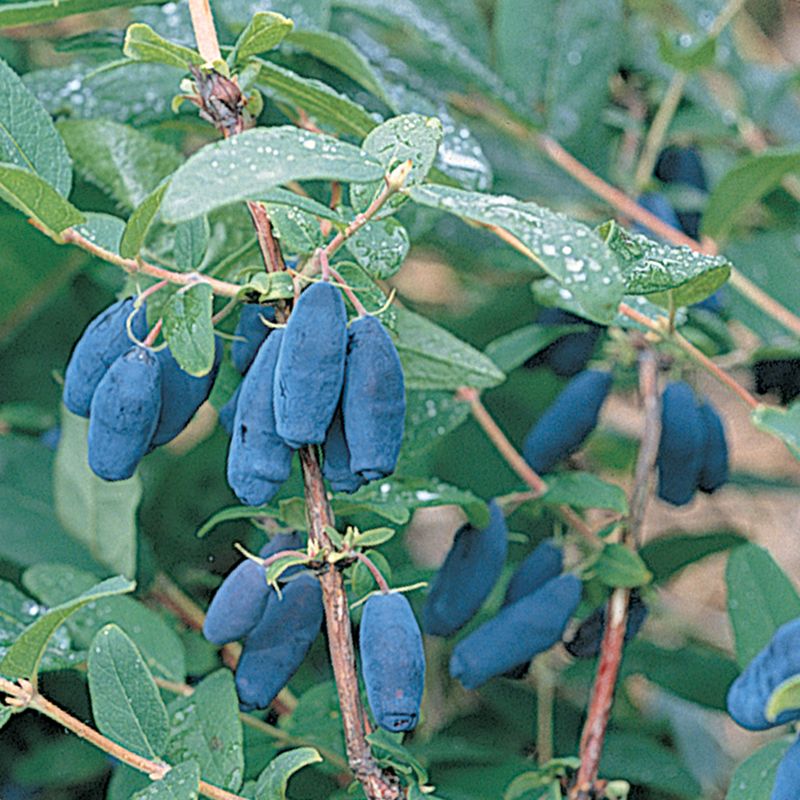
Berry Blue™ Honeyberry Plant
Description
Berry Blue™ Honeyberry tastes like wild blueberries with a hint of currant — a flavor combination that’s genuinely distinctive and consistently surprising to first-time tasters who expect something more straightforwardly sweet. Native to Siberia and northern Japan, honeyberries are adapted to extreme cold and short growing seasons, ripening large, firm, juicy blue berries in late May to early June — two weeks before strawberries — when fresh local fruit is still weeks away for most northern gardeners. Outstanding for fresh eating but truly exceptional made into jam, where the complex wild-fruit character concentrates beautifully. Cream-colored flowers in spring, cold-hardy in Zones 3–8, and tolerant of a wide soil pH range from 5.5–7.5. A pollinator is required.
Complex Wild-Fruit Flavor — Sweet, Tart, With a Currant Finish
The flavor comparison is accurate and worth understanding before planting. Berry Blue™ doesn’t taste like cultivated blueberries — it has the more complex, slightly tart, deeply fruity character of wild blueberries, with an additional hint of currant that adds a layer of interest that cultivated blueberries rarely deliver. That complexity makes it particularly outstanding for jams and preserves where the flavor can carry through the cooking process and stand on its own with minimal added sugar.
Two Weeks Before Strawberries — One of the First Fruits of the Season
The late May to early June ripening timing is Berry Blue™'s most practically valuable quality for northern home growers. When most fruiting plants are still weeks from their first harvest, Berry Blue™ is already delivering large, firm, juicy berries — the genuine first fresh fruit of the season in Zone 3–5 gardens where the season starts late. That early timing makes every handful feel particularly rewarding.
Wide pH Tolerance — Grows Where Blueberries Won’t
One of the most significant practical advantages of honeyberries over blueberries is the soil pH flexibility. Blueberries demand pH 4.5–5.5 and fail or perform poorly outside that narrow range. Berry Blue™ tolerates pH 5.5–7.5 — a much wider range that includes most garden soils without amendment — opening berry production to gardens where blueberry growing has always been impractical.
Why Growers Choose Berry Blue™ Honeyberry
- Wild blueberry with a hint of currant — complex flavor outstanding for fresh eating and jam
- Two weeks before strawberries — one of the first fruits of the season
- Large, firm, juicy blue berries — substantial and satisfying at harvest
- Wide pH tolerance 5.5–7.5 — grows where blueberries won’t
- Siberian native, cold-hardy to Zone 3 — built for northern gardens
- Bears in 1–2 years — quick reward from a long-lived planting
Survival Guaranteed!

Since 1816, Stark Bro’s has promised to provide customers with the very best fruit trees and plants. It’s just that simple. If your trees or plants do not survive, please let us know within one year of delivery. We will send you a free one-time replacement, with a nominal shipping fee of $9.99. If the item in question is not available, we can issue you a refund. Read more about our warranty policy.
Characteristics
| Characteristic Name | Value |
|---|---|
| Bloom Color | Cream, White |
| Bloom Time | Early |
| Chill Hours | 1000 - 1200 |
| Fruit Color | Blue |
| Fruit Size | Large |
| Hardiness Zone Range | 3 - 8 |
| Pollination | Pollinator Required |
| Ripens/Harvest | Late May, Early June |
| Characteristic Name | Value |
|---|---|
| Shade/Sun | Full Sun |
| Soil Composition | Loamy |
| Soil Moisture | Well Drained |
| Soil pH Level | 5.5 - 7.5 |
| Taste | Sweet |
| Texture | Juicy, Firm |
| Years to Bear | 1 - 2 |
Size & Spacing
Mature Size
Recommended Spacing
Zone Compatibility
Pollination
This variety requires another one for adequate pollination.
Tools & Supplies
Planting & Care
Learn all about how to grow honeyberry plants in The Growing Guide. An entire section of our website dedicated to your growing success.