
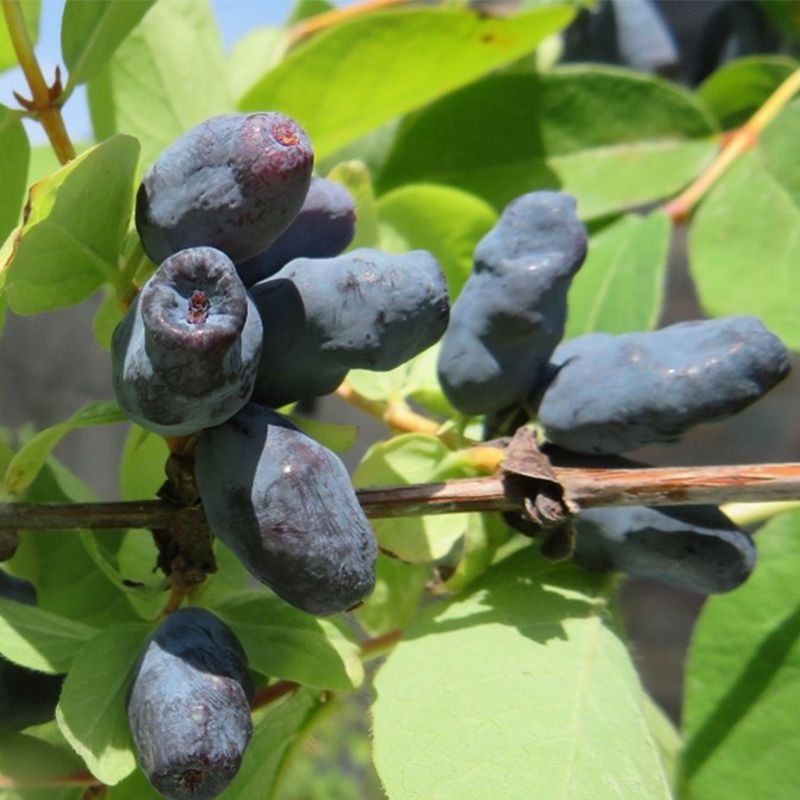
Blue Moose Honeyberry Plant
Description
Blue Moose Honeyberry produces some of the sweetest, largest berries in the honeyberry family — curved, approximately 1-inch berries with a satisfying dense bite and a sweeter flavor profile than most honeyberry varieties, ripening mid-June through mid-July in heavy crops that reach 8–10 pounds per bush once established. The naturally dome-shaped, densely structured plant maintains its attractive 5-foot form without any pruning — it simply grows into a tidy, productive rounded shape on its own, year after year, making it one of the most genuinely hands-off fruiting shrubs available. Packed with antioxidants, cold-hardy to Zone 2, and an attractive edible landscape addition. A pollinator is required — plant a compatible early-blooming honeyberry variety nearby.
Sweeter Than Most Honeyberries — Dense, Satisfying Bite
Blue Moose leans noticeably sweeter than the more tart honeyberry varieties — a flavor profile that makes it the natural choice for fresh snacking where approachable sweetness matters, and outstanding for any application where you want the berry’s flavor to shine without much added sugar. The dense, chewy texture gives each 1-inch berry a satisfying substantiality that lighter, softer varieties don’t deliver — more like biting into a small plum than a soft berry.
8–10 Pounds Per Bush — Natural Dome Shape, Zero Pruning
The yield potential is genuinely impressive for a compact 5-foot shrub. Once established after a couple of years, Blue Moose produces 8–10 pounds of berries per bush — enough for fresh eating, freezing, and jam-making from a single well-placed planting. And unlike blueberries, raspberries, or blackberries that require annual pruning to maintain productivity, Blue Moose’s natural dome shape and dense branching structure maintains itself. No pruning, no annual cane management — just harvest and enjoy.
An Attractive Edible Landscape Plant
At a tidy 5 feet tall and wide with a natural rounded dome shape, Blue Moose earns its place in the landscape beyond its fruit production. The dense, attractive structure, the early cream-colored spring blooms, and the mid-summer blue berry display make it an ornamental presence through every season — a fruiting shrub that looks intentional and beautiful in a mixed border or as a standalone specimen.
Why Growers Choose Blue Moose Honeyberry
- Sweeter than most honeyberry varieties — approachable flavor for fresh snacking
- Large 1-inch curved berries with dense satisfying bite — among the biggest in the family
- 8–10 lbs per bush once established — exceptional yield for a 5-foot shrub
- Natural dome shape — zero pruning ever — genuinely hands-off productivity
- Attractive edible landscape plant — beautiful and productive in mixed borders
- Cold-hardy to Zone 2 — thrives in the most demanding northern climates
Survival Guaranteed!

Since 1816, Stark Bro’s has promised to provide customers with the very best fruit trees and plants. It’s just that simple. If your trees or plants do not survive, please let us know within one year of delivery. We will send you a free one-time replacement, with a nominal shipping fee of $9.99. If the item in question is not available, we can issue you a refund. Read more about our warranty policy.
Characteristics
| Characteristic Name | Value |
|---|---|
| Bloom Time | Early |
| Fruit Color | Blue |
| Fruit Size | Large |
| Hardiness Zone Range | 2 - 9 |
| Pollination | Pollinator Required |
| Ripens/Harvest | June |
| Characteristic Name | Value |
|---|---|
| Shade/Sun | Full Sun |
| Soil Composition | Loamy |
| Soil Moisture | Well Drained |
| Soil pH Level | 5.5 - 7.0 |
| Taste | Sweet |
| Years to Bear | 2 - 3 |
Size & Spacing
Mature Size
Zone Compatibility
Pollination
This variety requires another one for adequate pollination.
Tools & Supplies
Planting & Care
Learn all about how to grow honeyberry plants in The Growing Guide. An entire section of our website dedicated to your growing success.