
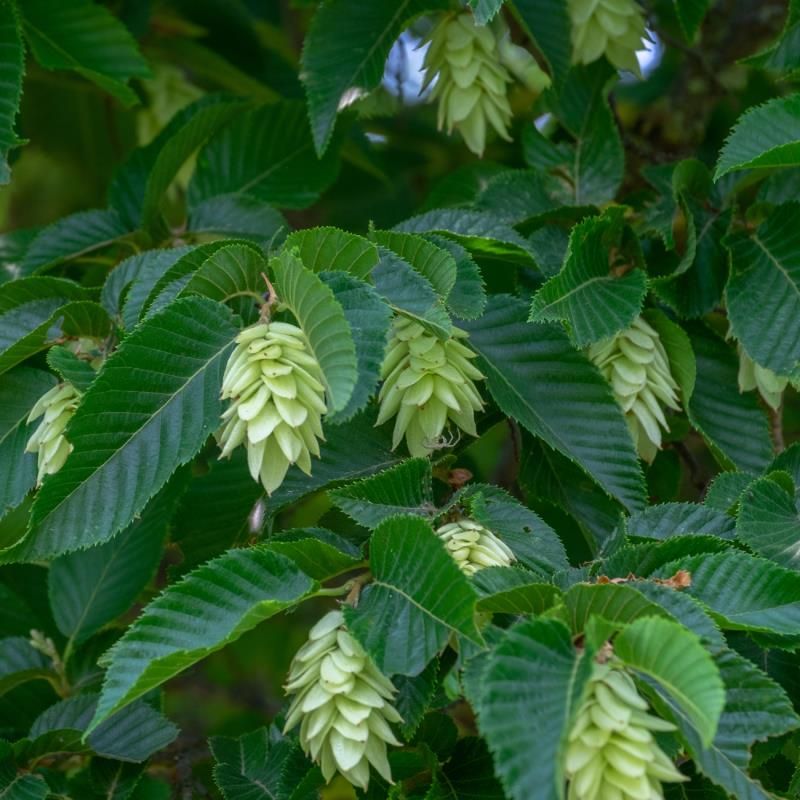
American Hophornbeam Tree
Description
American Hophornbeam (Ostrya virginiana) — also called Ironwood for its exceptionally hard, dense wood — is one of the most adaptable and underappreciated native trees in the American landscape. A slow-growing, long-lived small to medium shade tree with an extraordinary tolerance range: full sun to full deep shade, soils from acid to alkaline (pH 4.5–8.0), clay to sand, dry rocky slopes to moist woodland. Few native trees ask so little and give so much. The distinctive hop-like clusters of papery seed pods that give it its name hang decoratively from the branches through summer and into winter, feeding songbirds and small mammals and creating a visual texture unlike any other native tree. Cold hardy to Zone 3, deer resistant, compacted soil tolerant, and virtually pest and disease free.
Full Sun to Full Shade — An Extraordinary Adaptability Range
Most shade-tolerant trees have limited sun tolerance, and most sun-loving trees struggle in shade. American Hophornbeam (Ironwood) thrives across the entire spectrum — from full sun exposure to deep forest understory shade, naturally occurring as an understory tree beneath larger canopy while performing equally well in open lawn and park settings. That full-spectrum light adaptability, combined with a soil pH tolerance from 4.5 to 8.0 and good performance in clay, loam, sandy, and rocky soils, makes it one of the most genuinely site-flexible native trees available. Well-suited for lawns, parks, narrow tree lawns, and urban plantings — once established it makes excellent growth.
Distinctive Hop-Like Fruit Clusters — Ornamental and Wildlife-Valuable
The papery, inflated seed pod clusters that earn Hophornbeam its name are its most recognizable feature. Forming after the spring catkins, they hang in drooping clusters that transition from pale green to a warm tan-buff through summer and persist into winter — feeding songbirds, small mammals, and browse animals through the season when other food sources are limited. The male catkins are present throughout winter, adding subtle identification interest to the bare tree. No other native tree produces quite this fruit texture.
Ironwood — Among the Hardest Woods in North America
The “Ironwood” name is no exaggeration. Ostrya virginiana produces some of the densest, hardest wood of any native North American tree — historically prized for tool handles, mallets, fence posts, and other applications requiring exceptional durability. That same density and toughness that makes the wood remarkable also contributes to the tree’s exceptional resistance to ice and snow damage in the landscape — a meaningful practical advantage in northern climates where winter storm damage is a consistent concern.
Grayish-Brown Bark and Four-Season Character
American Hophornbeam’s grayish-brown bark, broken into narrow longitudinal strips that are free at each end, provides genuine ornamental interest through the winter months. Golden yellow fall color closes the season before the bark and persistent fruit clusters carry the winter display.
Why Growers Choose American Hophornbeam (Ironwood)
- Full sun to full deep shade — one of the widest light tolerance ranges of any native tree
- Soil pH 4.5–8.0 — acid to alkaline, adaptable to clay, loam, sandy, and rocky soils
- Ironwood — among the hardest native woods — exceptional resistance to ice and snow damage
- Distinctive hop-like fruit clusters — ornamental through summer and winter with wildlife value
- Grayish-brown shredding bark — four-season landscape interest
- Cold hardy to Zone 3 — proven across the widest range of American climates
- Deer resistant, drought tolerant, compacted soil tolerant — genuinely tough once established
- Virtually pest and disease free — low-maintenance for a lifetime
Characteristics
| Characteristic Name | Value |
|---|---|
| Hardiness Zone Range | 3 - 9 |
| Shade/Sun | Partial Shade - Full Sun |
| Characteristic Name | Value |
|---|---|
| Soil Moisture | Well Drained |
| Soil pH Level | 4.5 - 7.5 |
Zone Compatibility
Tools & Supplies

Planting & Care
Learn all about how to grow shade trees in The Growing Guide. An entire section of our website dedicated to your growing success.